






/NASA’s%20Artemis%20III%20Announcement%20(Official%20NASA%20Trailer)~thumb.jpg)

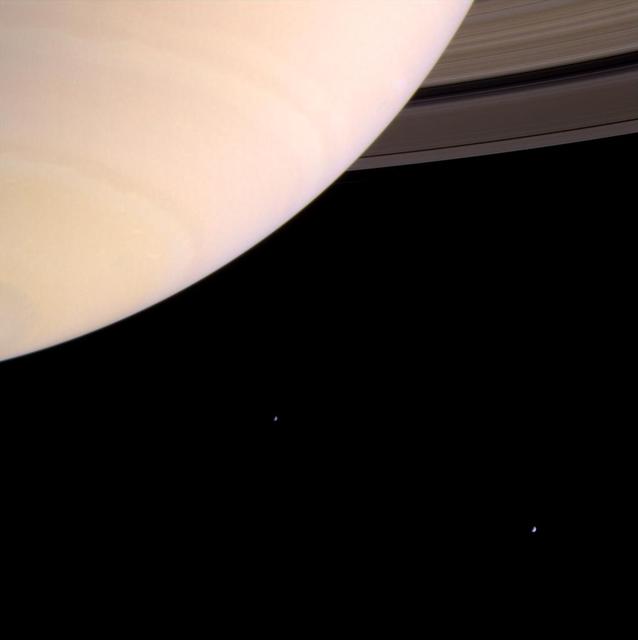
Epimetheus is a lonely dot beyond Saturn rings. The little moon appears at lower left, outside the narrow F ring. Several very faint spokes lurk in the B ring, at right
Ver en NASA ↗🚀 Biblioteca espacial oficial
Imágenes y vídeos de NASA
Explora el catálogo multimedia público de NASA sin salir de TuPortalNews.
Explora temas destacados
Selecciona un tema o realiza una búsqueda personalizada.
4.237 resultados en NASA
This map shows a dramatically improved view of heat radiation from a warm fissure near the south pole of Saturn icy moon Enceladus. It was obtained by NASA Cassini spacecraft during its Nov. 21, 2009, flyby of that moon.
Ver en NASA ↗Saturn A ring is decorated with several kinds of waves. NASA Cassini spacecraft has captured a host of density waves, a bending wave, and the edge waves on the edge of the Keeler gap caused by the small moon Daphnis.
Ver en NASA ↗Sunlight illuminates the deep cut of Ithaca Chasma on Saturn moon Tethys. Ithaca Chasma runs roughly north-south for more than 1,000 kilometers 620 miles on Tethys in this image captured by NASA Cassini spacecraft.
Ver en NASA ↗Crisp details on Dione contrast with the haziness of Titan in image from NASA Cassini spacecraft of a pair of Saturn moons. Smaller Dione is at the bottom of the image, and that moon wispy terrain is visible.
Ver en NASA ↗Wispy fractures cut through cratered terrain on Saturn moon Rhea in this high resolution, 3-D image from NASA Cassini spacecraft. 3D glasses are necessary to identify surface detail.
Ver en NASA ↗With Saturn terminator as a backdrop, this view of the unlit face of the rings makes it easy to distinguish between areas that are actual gaps, where light passes through essentially unimpeded, and areas where the rings block or scatter light
Ver en NASA ↗Saturn outermost large moon, Iapetus, has a bright, heavily cratered icy terrain and a dark terrain, as shown in this NASA Voyager 2 image taken on Aug. 22, 1981.
Ver en NASA ↗Lit by reflected light from Saturn, Enceladus appears to hover above the gleaming rings, its well-defined ice particle jets spraying a continuous hail of tiny ice grains
Ver en NASA ↗A seven-year journey to the ringed planet Saturn began on Oct. 15, 1997 with the liftoff of a Titan IVB/Centaur carrying NASA Cassini orbiter and its attached Huygens probe
Ver en NASA ↗The tiny moon Pandora appears beyond the bright disk of Saturn rings in this image taken by NASA Cassini spacecraft. Pandora orbits outside the F ring and, in this image, is farther from Cassini than the rings are.
Ver en NASA ↗NASA Cassini spacecraft snapped this image during the spacecraft closest flyby of Saturn moon Helene, on March 3, 2010. Helene is a Trojan moon of Dione, named for the Trojan asteroids that orbit ahead of and behind Jupiter.
Ver en NASA ↗Shadows seem ubiquitous in this view from NASA Cassini spacecraft of Saturn rings. The moon Pan casts a long shadow towards the right from where it orbits in the Encke Gap of the A ring in the upper right of the image.
Ver en NASA ↗Saturn moon Prometheus casts a long shadow across the A ring in the middle-right side of this image taken shortly before the planet August 2009 equinox by NASA Cassini spacecraft.
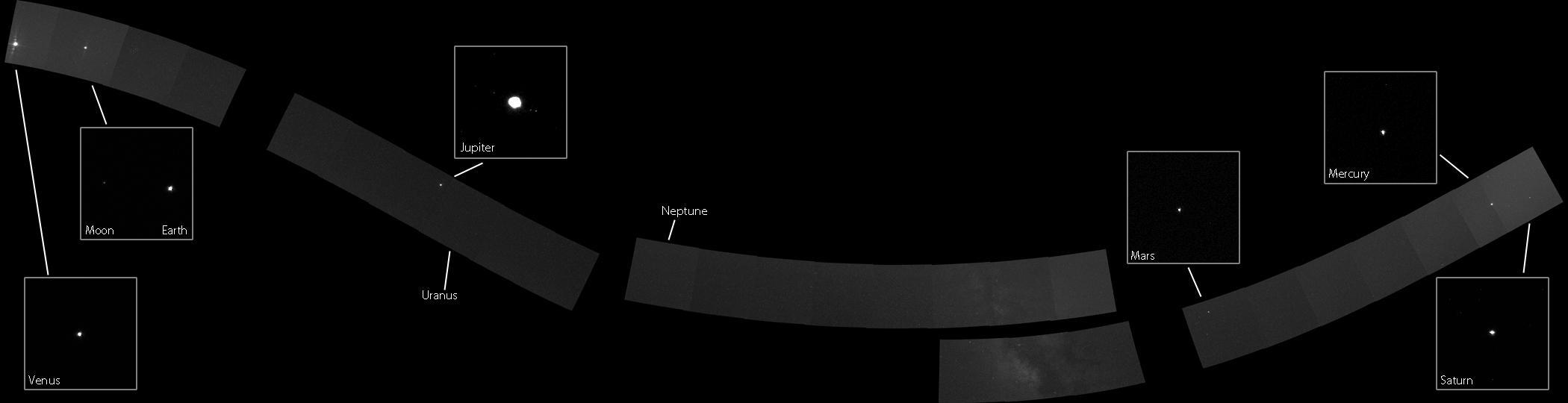
Ver en NASA ↗The cameras on NASA Cassini spacecraft captured this rare look at Earth and its moon from Saturn orbit on July 19, 2013. The image has been magnified five times.
Ver en NASA ↗Saturn small moon Pan casts a long shadow across the A ring in this image captured by NASA Cassini spacecraft a few days after the planet August 2009 equinox.
Ver en NASA ↗The northern hemisphere of Saturn moon Dione is seen in this polar stereographic maps, mosaicked from the best-available clear-filter images from NASA Cassini and Voyager missions.
Ver en NASA ↗These two images, taken four years before Saturn’s August 2009 equinox by NASA Cassini spacecraft, indicate the streaks in these images are likely evidence of impacts into the planet’s rings.
Ver en NASA ↗In this image taken by NASA Cassini spacecraft two light sources illuminate Saturn highly reflective moon Enceladus featuring bright rings and the small moon Pandora in the foreground.
Ver en NASA ↗The Apollo/Saturn 501 spacecraft undergoes checkout in test stand within the Kennedy Space Center’s Manned Spacecraft Operations Building in preparation for the first flight of NASA’s Saturn V space vehicle in the second quarter of this year. The command mod…
Ver en NASA ↗Apollo/Saturn Program: In January 1962, NASA initiated development of the large launch vehicle for the Project Apollo manned lunar flights. The Saturn V configuration comprised the S-IC first stage, the S-II second stage and the S-IVB third stage, all integ…
Ver en NASA ↗Pioneer Saturn PMOC (Mission Control Center)
Ver en NASA ↗WATER MAIN BREAK AT KSC - SATURN CAUSEWAY
Ver en NASA ↗Pioneer Saturn PMOC (Mission Control Center)
Ver en NASA ↗Contenido y metadatos proporcionados por la NASA Image and Video Library.