






/NASA’s%20Artemis%20III%20Announcement%20(Official%20NASA%20Trailer)~thumb.jpg)

The clumpy disturbed appearance of the brilliant F ring constantly changes. The irregular structure of the ring is due, in large part, to the gravitational perturbations on the ring material by one of Saturn moons, Prometheus
Ver en NASA ↗🚀 Biblioteca espacial oficial
Imágenes y vídeos de NASA
Explora el catálogo multimedia público de NASA sin salir de TuPortalNews.
Explora temas destacados
Selecciona un tema o realiza una búsqueda personalizada.
4.237 resultados en NASA
NASA Cassini spacecraft chronicles the change of seasons as it captures clouds concentrated near the equator of Saturn largest moon, Titan. Methane clouds in the troposphere, the lowest part of the atmosphere, appear white here.
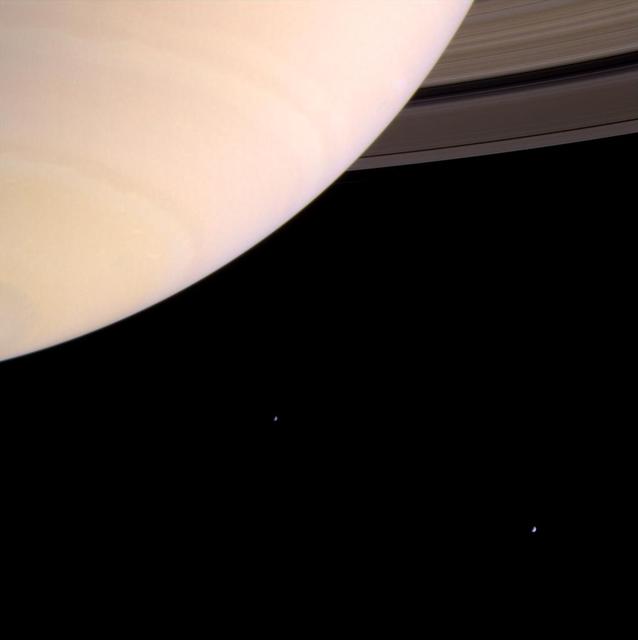
Ver en NASA ↗A pair of Saturn many moons joins the planet in this scene captured by NASA Cassini spacecraft. Tethys appears as a small white dot above the rings on the far left, Enceladus appears as a smaller bright speck beside the planet.
Ver en NASA ↗Saturn potato-shaped moon Prometheus is rendered in three dimensions in this close-up from NASA Cassini spacecraft. You will need 3-D glasses to view this image.
Ver en NASA ↗Iapetus shows off its puzzling light and dark terrain in this image captured by NASA Cassini spacecraft. Lit terrain seen here is on the Saturn-facing side of Iapetus.
Ver en NASA ↗Saturn A ring displays a marked asymmetry in brightness between the region nearer to the Cassini spacecraft and the region farther from it. The A ring is the broad, bright section of the rings outside of the dark B ring
Ver en NASA ↗Saturn rings appear as only a thin line seen edge-on in the middle of this view from NASA Cassini spacecraft, but the rings cast broad shadows on the southern hemisphere of the planet in the lower left of the image.
Ver en NASA ↗A propeller-shaped structure created by an unseen moon is brightly illuminated on the sunlit side of Saturn rings in this image obtained by NASA Cassini spacecraft. The moon, which is too small to be seen, is marked with a red arrow.
Ver en NASA ↗NASA Cassini spacecraft views the cratered surface of Saturn moon Tethys in front of the hazy orb of the planet largest moon, Titan. Tethys is much closer than Titan to Cassini.
Ver en NASA ↗Saturn rings cut across this view of the planet largest moon, Titan. Dark albedo features on Titan 5,150 kilometers, or 3,200 miles across and the moon north polar hood are visible in this image captured by NASA Cassini spacecraft.
Ver en NASA ↗Capturing the interplay between light and shadow, NASA Cassini spacecraft looks toward the night side of Saturn where sunlight reflected off the rings has dimly illuminated what would otherwise be the dark side of the planet.
Ver en NASA ↗Ring material, pulled to spectacular heights above the ring plane by the gravity of the moon Daphnis, casts long shadows on Saturn’s A ring in this Cassini image taken about a month before the planet’s August 2009 equinox.
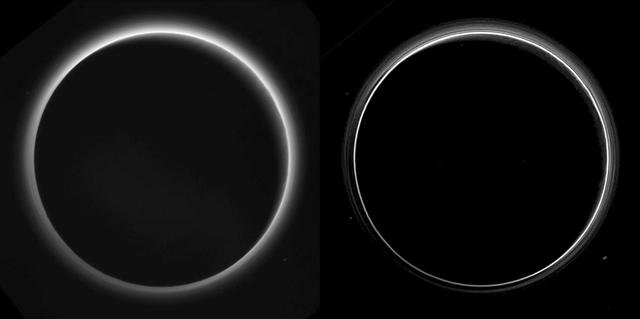
Ver en NASA ↗NASA Cassini spacecraft looks toward the dark side of Titan as a circle of light is produced by sunlight scattering through the periphery of the atmosphere of Saturn largest moon. A detached, high-altitude global haze layer encircles the moon.
Ver en NASA ↗This frame from a movie is based on data from NASA Cassini spacecraft and shows a flyover of an area of Saturn moon Titan known as Sotra Facula. Scientists believe Sotra is the best case for an ice volcano, or cryovolcano, region on Titan.
Ver en NASA ↗On April 14th 1970, the Apollo 13 Saturn IVB upper stage impacted the Moon North of Mare Cognitum, at -2.55° latitude, -27.88° East longitude. This image was taken by NASA Lunar Reconnaissance Orbiter.
Ver en NASA ↗At top of this image, Saturn moon Dione may appear closer to the spacecraft because it is larger than the moon Enceladus in the lower left. However, Enceladus was actually closer to the spacecraft in this image captured by NASA Cassini spacecraft.
Ver en NASA ↗Orbiting in the Encke Gap of Saturn A ring, the moon Pan casts a shadow on the ring in this image taken about six months after the planet August 2009 equinox by NASA Cassini spacecraft.
Ver en NASA ↗The two-toned surface of Saturn moon Iapetus is demonstrated in the dark region of the moon visible on the top left and the bright crater in the lower right of this portrait captured by NASA Cassini spacecraft.
Ver en NASA ↗Saturn is overexposed in this image taken by NASA Cassini spacecraft in order to show the dim rings. Pandora below rings to the left has been brightened by a factor of 1.3 relative to the planet and the rings to enhance its visibility.
Ver en NASA ↗This image is from a simulation showing the changes to a portion of Saturn F ring as the shepherding moon Prometheus swings by it. The animation uses data obtained by the imaging cameras aboard NASA Cassini spacecraft.
Ver en NASA ↗NASA Cassini spacecraft watches Saturn small moon Epimetheus orbiting beyond the planet rings. Epimetheus orbits beyond the thin F ring near the bottom center of this view.
Ver en NASA ↗Clumps of ring material are revealed along the edge of Saturn A ring in this image taken during the planet August 2009 equinox. The granular appearance of the outer edge of the A ring is likely created by gravitational clumping of particles there.
Ver en NASA ↗NASA Cassini spacecraft spied details on the pockmarked surface of Saturn moon Prometheus 86 kilometers, or 53 miles across during a moderately close flyby on Dec. 6, 2015. This is one of Cassini highest resolution views of Prometheus.
Ver en NASA ↗The shadows of Saturn rings cast onto the planet appear as a thin band at the equator in this image taken by NASA Cassini spacecraft as the planet approached its August 2009 equinox.
Ver en NASA ↗Contenido y metadatos proporcionados por la NASA Image and Video Library.