






/NASA’s%20Artemis%20III%20Announcement%20(Official%20NASA%20Trailer)~thumb.jpg)

This map of Saturn moon Titan by the Cassini radar mapper using its synthetic aperture radar imaging mode. Shown are a variety of geologic features, including impact craters, wind-blown deposits, channels and cryovolcanic features
Ver en NASA ↗🚀 Biblioteca espacial oficial
Imágenes y vídeos de NASA
Explora el catálogo multimedia público de NASA sin salir de TuPortalNews.
Explora temas destacados
Selecciona un tema o realiza una búsqueda personalizada.
4.237 resultados en NASA
Saturn rings obscure part of Titan colorful visage in this image from NASA Cassini spacecraft. The south polar vortex that first appeared in Titan atmosphere in 2012 is visible at the bottom of this view.
Ver en NASA ↗Inspired by data from NASA Cassini mission, this artist impression of Saturn moon Titan shows the change in observed atmospheric effects before, during and after equinox in 2009.
Ver en NASA ↗The moon Tethys stands out as a tiny crescent of light in front of the dark of Saturn night side. Tethys can be seen above the ringplane on the far right of this NASA Cassini spacecraft image.
Ver en NASA ↗The Cassini spacecraft spies multiple spokes in Saturn outer B ring. The precise origin and evolution of these transient features continue to provide ring scientists with intriguing puzzles to solve
Ver en NASA ↗This image shows rough ice in the southern part of Saturn moon Enceladus. It was created using synthetic-aperture radar SAR data acquired by NASA Cassini spacecraft on Nov. 6, 2011.
Ver en NASA ↗These polar maps show the first global, topographic mapping of Saturn moon Titan, using data from NASA Cassini mission. To create these maps, scientists employed a mathematical process called splining.
Ver en NASA ↗This mosaic, made from radar images obtained by NASA Cassini spacecraft, shows parallel mountain chains on Saturn moon Titan. The mountains appear along the northwest border of a region known as Xanadu.
Ver en NASA ↗An enigmatic large basin appears in the south polar region of Saturn moon Titan at the center of this Titan Radar Mapper image from NASA Cassini spacecraft acquired on June 22, 2009.
Ver en NASA ↗Saturn moon Enceladus brightly reflects sunlight before a backdrop of the planet rings and the rings shadows cast onto the planet. NASA Cassini spacecraft captured this snapshot during its flyby of the moon on Nov. 30, 2010.
Ver en NASA ↗NASA Cassini spacecraft looks past the cratered south polar area of Saturn moon Rhea to spy the moon Dione and the planet rings in the distance. Dione wispy terrain can be seen on the trailing hemisphere of that moon.
Ver en NASA ↗Saturn small moon Daphnis is caught in the act of raising waves on the edges of the Keeler gap, which is the thin dark band in the left half of the image. Waves like these allow scientists to locate small moons in gaps and measure their masses.
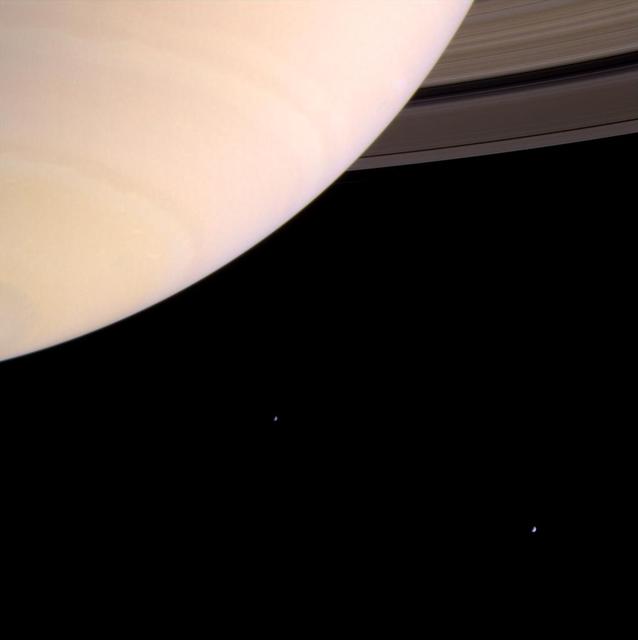
Ver en NASA ↗s our robotic emissary to Saturn, the Cassini spacecraft is privileged to behold such fantastic sights as this pairing of two moons beyond the rings. The bright, narrow F ring is the outermost ring structure seen here
Ver en NASA ↗Ligeia Mare, shown here in a false color image from NASA Cassini mission, is the second largest known body of liquid on Saturn moon Titan. It is filled with liquid hydrocarbons, such as ethane and methane.
Ver en NASA ↗Saturn moon Dione, in the foreground of this image from NASA Cassini spacecraft, appears darker than the moon Tethys. Tethys appears brighter because it has a higher albedo than Dione, meaning Tethys reflects more sunlight.
Ver en NASA ↗A crescent Enceladus appears with Saturn rings in this view of the moon from NASA Cassini spacecraft. The famed jets of water ice emanating from the south polar region of the moon are faintly visible here.
Ver en NASA ↗Bright sunlight on Rhea shows off the cratered surface of Saturn second largest moon in this image captured by NASA Cassini Orbiter. The image was taken in visible light with the Cassini spacecraft narrow-angle camera on Sept. 21, 2009.
Ver en NASA ↗Two of Saturn icy moons pass each other in a mutual event recorded by NASA Cassini spacecraft. The smaller moon Enceladus passes in front of the larger moon Rhea.
Ver en NASA ↗This graphic illustrates the interior of Saturn moon Enceladus. It shows warm, low-density material rising to the surface from within, in its icy shell yellow and/or its rocky core red
Ver en NASA ↗Saturn fourth largest moon, Dione, appears like a solitary ornament suspended above the rings in view from NASA Cassini spacecraft. The rings are closer to Cassini in this view, with Dione more distant.
Ver en NASA ↗Pan is seen in this color view as it sweeps through the Encke Gap with its attendant ringlets. As the lemon-shaped little moon orbits Saturn, it always keeps its long axis pointed along a line toward the planet
Ver en NASA ↗A trio of large storms embraces in Saturn high north. The three prominent vortices seen here are each wide enough to span the distance from New York City to Denver, or from London to Moscow
Ver en NASA ↗An intricate, fingerprint-like pattern of dunes is seen in this dramatic radar image of Saturn moon Titan captured by NASA Cassini spacecraft on May 21, 2009 from an altitude of 965 kilometers about 600 miles.
Ver en NASA ↗This mosaic, made from radar images obtained by NASA Cassini spacecraft, shows mountainous terrain on Saturn moon Titan in the moon northern hemisphere, north of the Aaru region.
Ver en NASA ↗Contenido y metadatos proporcionados por la NASA Image and Video Library.