






/NASA’s%20Artemis%20III%20Announcement%20(Official%20NASA%20Trailer)~thumb.jpg)

NASA Cassini spacecraft swooped in for a close-up of the cratered, fractured surface of Saturn moon Dione in this image taken during the spacecraft Jan. 27, 2010, non-targeted flyby.
Ver en NASA ↗🚀 Biblioteca espacial oficial
Imágenes y vídeos de NASA
Explora el catálogo multimedia público de NASA sin salir de TuPortalNews.
Explora temas destacados
Selecciona un tema o realiza una búsqueda personalizada.
4.237 resultados en NASA
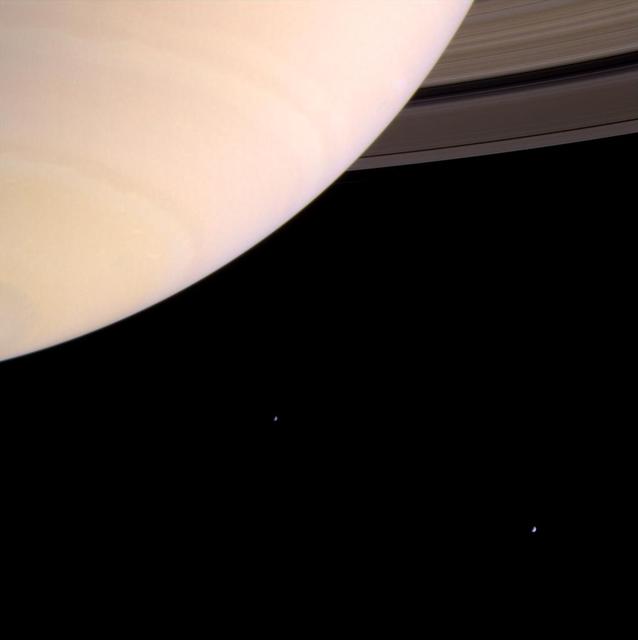
Quiet and cold, a crescent Tethys floats above the nearly edge-on rings of Saturn. The only surface features visible on Tethys 1,071 kilometers, or 665 miles across from this distance are a few impact craters
Ver en NASA ↗Sunlight highlights the bright, wispy features on the trailing hemisphere of Saturn moon Dione as seen by NASA Cassini spacecraft. These wispy features are a system of braided canyons with bright walls caused by fractures.
Ver en NASA ↗Cassini looks toward northern latitudes on Saturn and out across the ringplane. This infrared view probes clouds beneath the hazes that obscure the planet depths in natural color views
Ver en NASA ↗This global map of Saturn moon Dione was created using images taken during flybys by NASA Cassini spacecraft. Images from NASA Voyager mission fill the gaps in Cassini coverage.
Ver en NASA ↗Icy fractures on Saturn moon Rhea reflect sunlight brightly in this high-resolution mosaic created from images captured by NASA Cassini spacecraft during its March 2, 2010, flyby.
Ver en NASA ↗A quintet of Saturn moons come together in this portrait from NASA Cassini spacecraft. Janus is seen on the far left, Pandora orbits near the middle, Enceladus appears above the center, and Rhea and Mimas are seen on the right side.
Ver en NASA ↗Enceladus dramatically displays the contrast between its older and newer terrain as seen by NASA Cassini spacecraft. This view looks toward the anti-Saturn side of Enceladus. North on Enceladus is up and rotated 36 degrees to the right.
Ver en NASA ↗Saturn moon Hyperion pops into view in this stereo anaglyph created from NASA Cassini images; differing views are helpful in interpreting the moon irregular shape. 3D glasses are necessary to view this image.
Ver en NASA ↗Saturn small, potato-shaped moon Prometheus appears embedded within the planet rings near the center of this view from NASA Cassini spacecraft while the larger moon Mimas orbits beyond the rings.
Ver en NASA ↗Saturn shadow interrupts the planet rings, leaving just thin slivers of the rings visible in this image, which shows a pair of the planet small moons. Helene is in the center top of the image, Epimetheus is in the lower right.
Ver en NASA ↗NASA Cassini spacecraft composition features Saturn rings top of image, its second largest moon, Rhea on right of image, and one of the planet tiny moons, Telesto near the middle of image appears as a bright speck.
Ver en NASA ↗This global digital map of Saturn moon Mimas was created using data taken during Cassini and Voyager spacecraft flybys. The map is an equidistant projection and has a scale of 434 meters 1,424 feet per pixel
Ver en NASA ↗Saturn F ring often appears to do things other rings dont. In this image from NASA Cassini spacecraft, a strand of ring appears to separate from the core of the ring as if pulled apart by mysterious forces.
Ver en NASA ↗Cassini came close to Saturn small moon Helene on Feb. 25, 2006, acquiring this high-resolution view. This object seems to be buried in its own crater debris, like another Saturnian moon, Telesto
Ver en NASA ↗Saturn moon Pan, orbiting in the Encke Gap near the top of the image, casts a short shadow on the A ring in this image taken by NASA Cassini spacecraft about six months after the planet August 2009 equinox.
Ver en NASA ↗A seven-year journey to the ringed planet Saturn began on Oct. 15, 1997 with the liftoff of a Titan IVB/Centaur carrying NASA Cassini orbiter and its attached Huygens probe.
Ver en NASA ↗This artist concept illustrates the two Saturn-sized planets discovered by NASA Kepler mission. The star system is oriented edge-on, as seen by Kepler, such that both planets cross in front, or transit, their star, named Kepler-9.
Ver en NASA ↗NASA Cassini spacecraft looks between Saturn A and B rings to spy structure in the Cassini Division. The Cassini Division, occupying the middle and left of the image, contains five dim bands of ring material, but not all of the division is shown here.
Ver en NASA ↗Saturn moon Enceladus reflects sunlight brightly while the planet and its rings fill the background in this view from NASA Cassini spacecraft. Enceladus is one of the most reflective bodies in the solar system.
Ver en NASA ↗This map of Saturn moon Titan identifies the locations of mountains named by the International Astronomical Union. By convention, mountains on Titan are named for mountains from Middle-earth, the fictional setting in fantasy novels by J.R.R. Tolkien.
Ver en NASA ↗This global digital map of Saturn moon Iapetus was created using data taken during Cassini and Voyager spacecraft flybys. The map is an equidistant projection and has a scale of 641 meters 2,103 feet per pixel
Ver en NASA ↗NASA Cassini spacecraft captures a view of the southern latitudes of Saturn tumbling moon Hyperion. Lit terrain seen here is mostly in the southern hemisphere of Hyperion. The south pole of the moon is near the bottom of the illuminated terrain.
Ver en NASA ↗This frame from an animated sequence of NASA Cassini images shows methane clouds moving above the large methane sea on Saturn moon Titan known as Ligeia Mare.
Ver en NASA ↗Contenido y metadatos proporcionados por la NASA Image and Video Library.