






/NASA’s%20Artemis%20III%20Announcement%20(Official%20NASA%20Trailer)~thumb.jpg)

This mosaic of images from NASA Cassini spacecraft depicts fan-like structures in Saturn tenuous F ring. Bright features are also visible near the core of the ring. Such features suggest the existence of additional objects in the F ring.
Ver en NASA ↗🚀 Biblioteca espacial oficial
Imágenes y vídeos de NASA
Explora el catálogo multimedia público de NASA sin salir de TuPortalNews.
Explora temas destacados
Selecciona un tema o realiza una búsqueda personalizada.
4.237 resultados en NASA
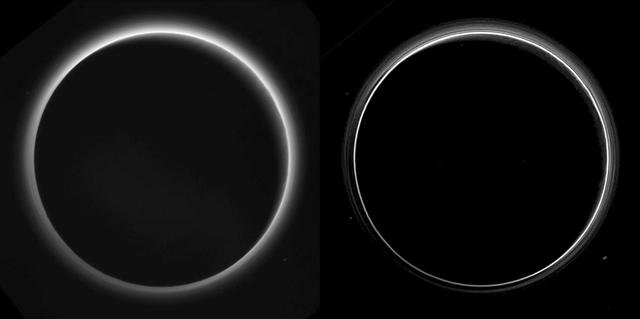
As ring particles emerge from the darkness of Saturn shadow, they pass through a region of twilight. The Sun light, refracted by the planet atmosphere, peeks around the limb, followed shortly by the Sun itself
Ver en NASA ↗This global digital map of Saturn moon Tethys was created using data taken during Cassini and Voyager spacecraft flybys. The map is an equidistant projection and has a scale of 293 meters 961 feet per pixel
Ver en NASA ↗Saturn tiny moon Pan orbits in the middle of the Encke Gap of the planet A ring in this image from the Cassini spacecraft. Pan is visible as a bright dot in the gap near the center of this view.
Ver en NASA ↗This panel of images shows the nearly spherical shape of Saturn moon Phoebe, as derived from imaging obtained from NASA Cassini spacecraft. Each image represents a 90-degree turn.
Ver en NASA ↗Wispy terrain stretches across the trailing hemisphere of Saturn moon Dione on the right of this image taken by NASA Cassini spacecraft during the spacecraft flyby on April 7, 2010.
Ver en NASA ↗Saturn moon Mimas peeks out from behind the night side of the larger moon Dione in this image captured by NASA Cassini spacecraft during the Dione flyby of Dec. 12, 2011.
Ver en NASA ↗Saturn rings cast wide shadows on the planet, and the shadow of a moon also graces the gas giant in this scene from NASA Cassini spacecraft. The moon Enceladus is not shown in this view, but it does cast a small, elongated shadow.
Ver en NASA ↗False-color images from NASA Cassini spacecraft show the development of a hood of high-altitude haze, which appears orange in this image, forming over the south pole of Saturn moon Titan.
Ver en NASA ↗A dense network of small rivers or swampy areas appears to connect some of the seas on Saturn moon Titan, as seen in this comparison of data of the same area from two instruments on NASA Cassini spacecraft.
Ver en NASA ↗Saturn moon Enceladus orbits serenely before a backdrop of clouds roiling the atmosphere the planet in this image taken by NASA Cassini spacecraft. This view looks toward the northern, sunlit side of the rings from just above the ringplane.
Ver en NASA ↗Saturn fourth-largest moon, Dione, can be seen through the haze of the planet largest moon, Titan, in this view of the two posing before the planet and its rings from NASA Cassini spacecraft.
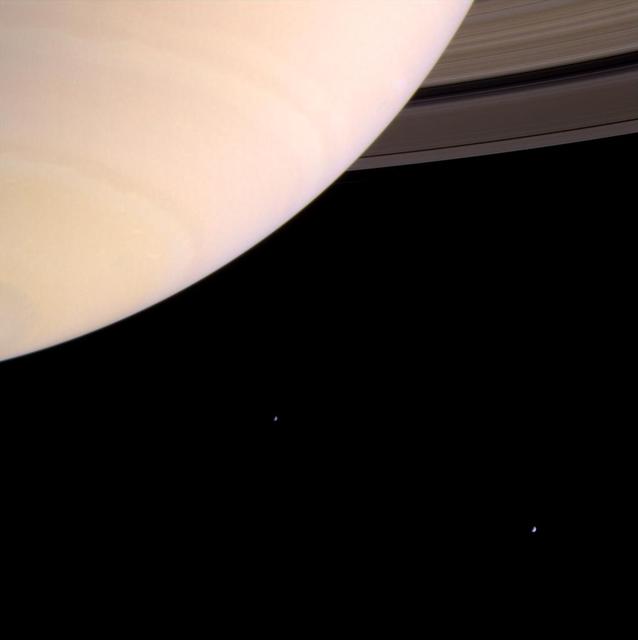
Ver en NASA ↗Shadows adorn Saturn in this view from NASA Cassini spacecraft, which also includes the moon Rhea, shown orbiting between the planet and the spacecraft and appears above the rings on the left of the image.
Ver en NASA ↗Jagged looking shadows stretch away from vertical structures of ring material created by the moon Daphnis in this image taken as Saturn approaches its August 2009 equinox.
Ver en NASA ↗NASA Cassini spacecraft looks toward the dark region of Belet on Saturn largest moon, Titan. This large region on the moon has a low albedo, meaning it diffusely reflects little light.
Ver en NASA ↗NASA Cassini imaging scientists processed this view of Saturn moon Dione, taken during a close flyby on June 16, 2015. This was Cassini fourth targeted flyby of Dione.
Ver en NASA ↗In this stunning image, NASA Cassini spacecraft looks at the dark side of Saturn largest moon. The narrowing circle of light surrounding Titan is produced by sunlight scattering through Titan atmosphere.
Ver en NASA ↗This sweeping mosaic of Saturn moon Enceladus provides broad regional context for the ultra-sharp, close-up views NASA Cassini spacecraft acquired minutes earlier, during its flyby on Aug. 11, 2008.
Ver en NASA ↗Huge clouds swirl through the southern latitudes of Saturn where the rings cast dramatic shadows. This view from NASA Cassini spacecraft looks toward the northern, sunlit side of the rings from just above the ringplane.
Ver en NASA ↗Orbiting near the plane of Saturn rings, NASA Cassini spacecraft looks across the span of the rings to spy the small moon Epimetheus. The brightest spoke is visible on the left of the image.
Ver en NASA ↗NASA Cassini spacecraft captures a mutual event between Titan and Mimas in front of a backdrop of the planet rings. This image was snapped shortly before Saturn largest moon passed in front of and occulted the small moon Mimas.
Ver en NASA ↗This graphic, constructed from data obtained by NASA Cassini spacecraft, shows the percentage of cloud coverage across the surface of Saturn moon Titan. The color scale from black to yellow signifies no cloud coverage to complete cloud coverage.
Ver en NASA ↗NASA Cassini spacecraft gazes at several albedo features on Saturn largest moon, Titan. Left to right are four dark regions: Fensal, Aztlan, Aaru and a part of Senkyo.
Ver en NASA ↗This global digital map of Saturn moon Dione was created using data taken during Cassini and Voyager spacecraft flybys. The map is an equidistant projection and has a scale of 977 meters 3,205 feet per pixel
Ver en NASA ↗Contenido y metadatos proporcionados por la NASA Image and Video Library.