






/NASA’s%20Artemis%20III%20Announcement%20(Official%20NASA%20Trailer)~thumb.jpg)

The Cassini spacecraft gazes down through the dark side of Saturn rings toward the softly glowing planet. The night side southern hemisphere is lit by sunlight reflecting off the opposite side of the rings
Ver en NASA ↗🚀 Biblioteca espacial oficial
Imágenes y vídeos de NASA
Explora el catálogo multimedia público de NASA sin salir de TuPortalNews.
Explora temas destacados
Selecciona un tema o realiza una búsqueda personalizada.
4.237 resultados en NASA
This image shows a high-resolution heat intensity map of part of the south polar region of Saturn moon Enceladus, made from data obtained by NASA Cassini spacecraft.
Ver en NASA ↗Saturn moon Rhea passes in front of Dione, as seen from NASA Cassini spacecraft. These images are part of a mutual event sequence in which one moon passes close to, or in front of, another.
Ver en NASA ↗The moon Rhea moves behind Saturn largest moon, Titan, in this mutual event imaged by NASA Cassini spacecraft. Part of Rhea southern hemisphere is also visible here through the haze of Titan atmosphere.
Ver en NASA ↗This image taken by NASA Cassini spacecraft in 2009, shows the first flash of sunlight reflected off a hydrocarbon lake on Saturn moon Titan. The glint off a mirror-like surface is known as a specular reflection.
Ver en NASA ↗It difficult to get a sense of scale when viewing Saturn rings, but the Cassini Division seen here between the bright B ring and dimmer A ring is almost as wide as the planet Mercury as seen by NASA Cassini spacecraft.
Ver en NASA ↗The shadow of Saturn moon Dione, cast onto the planet, is elongated in dramatic fashion in this image captured by NASA Cassini spacecraft. The moon itself does not appear here, but the shadow can be seen south of the ringplane.
Ver en NASA ↗This video demonstrates the hiss-like radio noise generated by electrons moving along magnetic field lines from the Saturnian moon Enceladus to a glowing patch of ultraviolet light on Saturn.
Ver en NASA ↗This series of images from NASA Cassini spacecraft shows changes on the surface of Saturn moon Titan, as the transition to northern spring brings methane rains to the moon equatorial latitudes.
Ver en NASA ↗Cassini scientists continue their quest to understand the origin and evolution of the newly discovered features observed in Saturn A ring which have become known as propellers as shown in this image from NASA Cassini spacecraft.
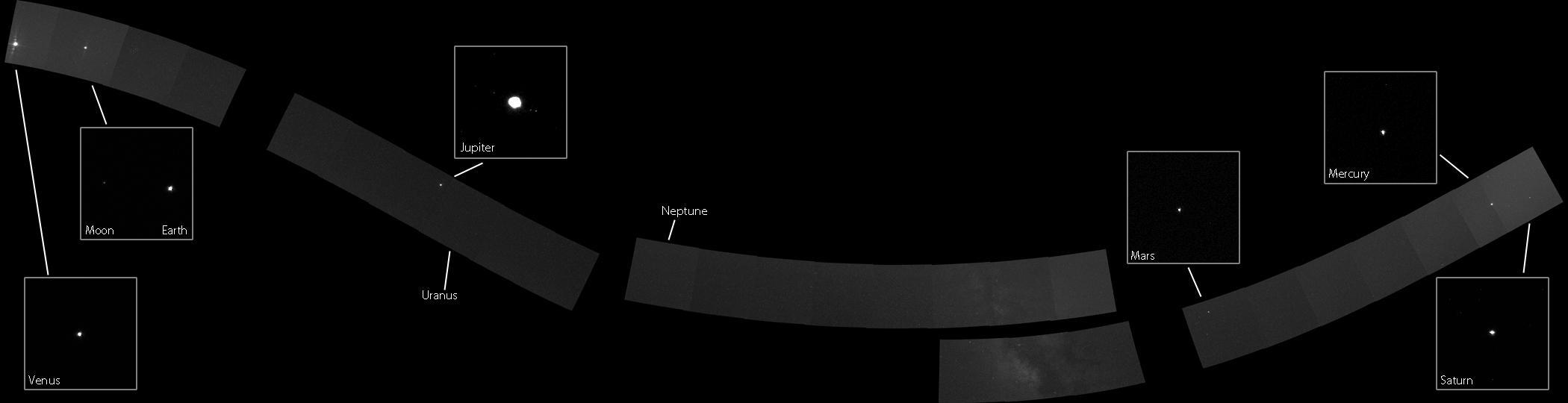
Ver en NASA ↗NASA Cassini casts powerful eyes on our home planet, and captures Earth, a pale blue orb, and a faint suggestion of our moon, among the glories of the Saturn system in this image taken Sept. 15, 2006.
Ver en NASA ↗This stunning false-color view of Saturn moon Hyperion reveals crisp details across the strange, tumbling moon surface. The view was obtained during NASA Cassini close flyby on Sept. 26, 2005.
Ver en NASA ↗NASA Cassini spacecraft turns the eye of its camera toward Saturn moon Mimas and spies the large Herschel Crater which itself looks like the iris of an eye peering out into space.
Ver en NASA ↗NASA Cassini spacecraft peers down through the hazy atmosphere of Saturn moon Titan to view the dark region called Belet. The large region called Belet has a low albedo, meaning it reflects little light.
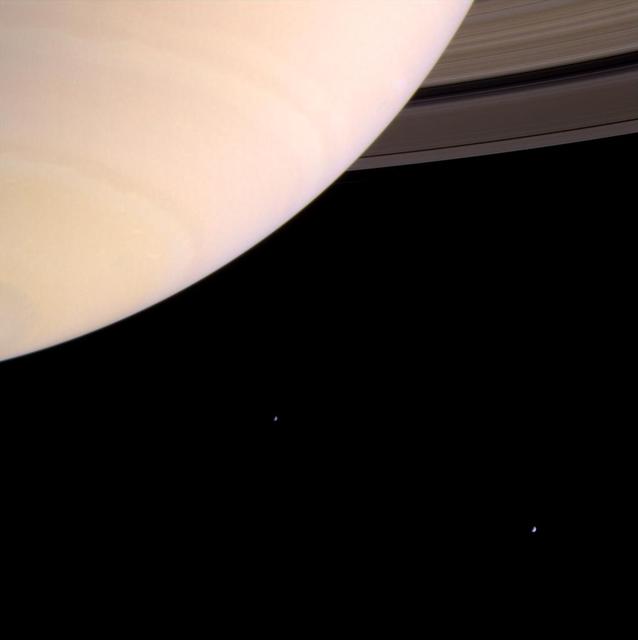
Ver en NASA ↗Two of Saturn small moons can be seen orbiting beyond the planet thin F ring in this image captured by NASA Cassini spacecraft. Pandora is on the left, and Epimetheus is on the right.
Ver en NASA ↗The brightly reflective moon Enceladus appears before Saturn rings while the larger moon Titan looms in the distance. Jets of water ice and vapor emanating from the south pole of Enceladus hinting at subsurface sea rich in organics.
Ver en NASA ↗NASA Cassini spacecraft looks toward the dark side of Saturn largest moon and captures the halo-like ring produced by sunlight scattering through the periphery of Titan atmosphere.
Ver en NASA ↗While NASA Cassini spacecraft was pointed to study Saturn F ring, it happened to catch a globular star cluster passing through the camera field of view. Animations are available at the Photojournal.
Ver en NASA ↗The shadow of the moon Mimas strikes the F ring at a different angle than the angle at which it is cast on the A ring, illustrating differences in the vertical heights of the rings in this image taken as Saturn approaches its August 2009 equinox.
Ver en NASA ↗This psychedelic view of Saturn and its rings is a composite made from images taken with the Cassini spacecraft wide-angle camera using spectral filters sensitive to wavelengths of infrared light
Ver en NASA ↗The shadow of Saturn moon Mimas is elongated across the planet in this image from NASA Cassini spacecraft. The moon itself is not shown, but the shadow appears just above the ringplane on the right of the image.
Ver en NASA ↗The south polar region of Saturn active, icy moon Enceladus awaits NASA Cassini spacecraft in this view, acquired on approach to the mission deepest-ever dive through the moon plume of icy spray.
Ver en NASA ↗Saturn moon Daphnis, appearing as a tiny speck in the Keeler Gap of the A ring on the far right of this NASA Cassini spacecraft image, is almost lost among the moon attendant edge waves.
Ver en NASA ↗NASA Cassini spacecraft spies a fan in Saturn tenuous F ring. This fan-like structure appears as dark lines spreading outward from the left of the bright clump of ring material near the center of the image.
Ver en NASA ↗Contenido y metadatos proporcionados por la NASA Image and Video Library.