






/NASA’s%20Artemis%20III%20Announcement%20(Official%20NASA%20Trailer)~thumb.jpg)

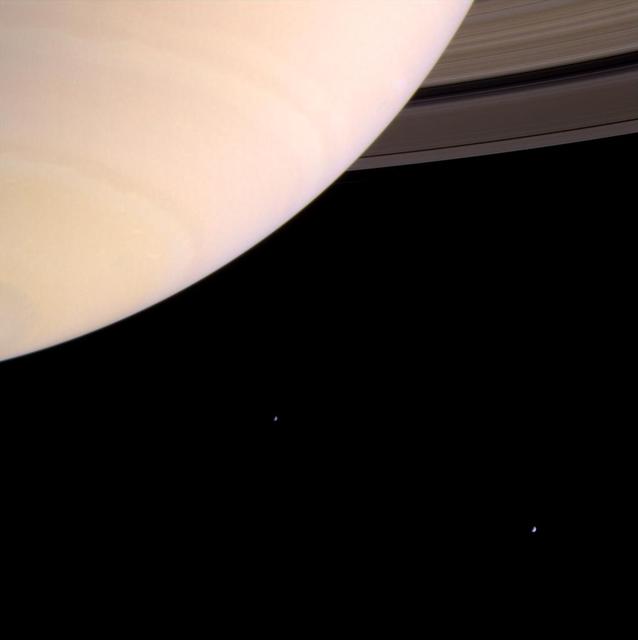
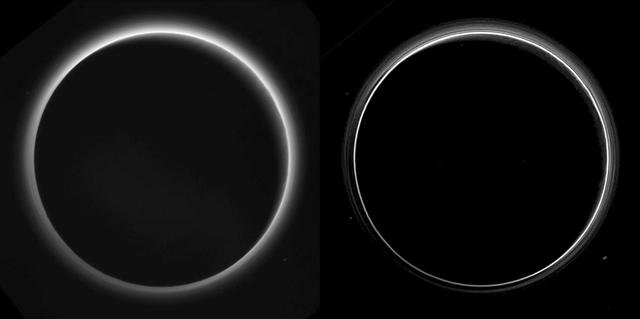
Cassini finds artistic harmony in the dark and icy realm of Saturn. The dim, unlit side of the rings is shown here. The narrow F ring appears bright when seen from angles near the plane of the rings
Ver en NASA ↗🚀 Biblioteca espacial oficial
Imágenes y vídeos de NASA
Explora el catálogo multimedia público de NASA sin salir de TuPortalNews.
Explora temas destacados
Selecciona un tema o realiza una búsqueda personalizada.
4.237 resultados en NASA
Saturn small, ring-embedded moon Pan, on the extreme right of this NASA Cassini spacecraft image, can be seen interacting with the ringlets that share the Encke Gap of the A ring with this moon.
Ver en NASA ↗Looking like half of a figure eight, two of Saturn moons appear conjoined in this image from NASA Cassini spacecraft. The moon Dione, at the top in the image, is actually closer to the spacecraft, appearing to blend seamlessly with the moon Rhea.
Ver en NASA ↗The moon Prometheus casts a shadow on Saturn F ring near a streamer-channel it has created on the ring. The image was taken as the planet approached its August 2009 equinox.
Ver en NASA ↗Two moons, Rhea and Dione, join the planet and its rings in this view from NASA Cassini spacecraft. Rhea and Dione are respectively the second and fourth largest moons of Saturn, but they are tiny compared to the planet.
Ver en NASA ↗NASA Cassini spacecraft looks across the surface of Saturn moon Dione and details the wispy terrain first chronicled by Voyager. This fractured terrain covers the trailing hemisphere of Dione.
Ver en NASA ↗The diminutive moon Mimas can be found hiding in the middle of this view of a crescent of Saturn bisected by rings in this image captured by NASA Cassini spacecraft. Mimas appears as a dark speck just about the ringplane near the center of the image. Th
Ver en NASA ↗This image, which at first appears to show a serene scene, in fact reveals dramatic disturbances created in Saturn A ring by its moon Daphnis as seen by NASA Cassini spacecraft.
Ver en NASA ↗This image is from an animation that glides along the shoreline of Ontario Lacus, the largest lake on the southern hemisphere of Saturn moon Titan. The animation is based on overlapping radar images obtained by NASA Cassini spacecraft.
Ver en NASA ↗NASA Cassini spacecraft looks toward Saturn largest moon, Titan, and spies the huge Kraken Mare in the moon north. Kraken Mare, a large sea of liquid hydrocarbons, is visible as a dark area near the top of the image.
Ver en NASA ↗It difficult not to think of an egg when looking at Saturn moon Methone, seen here during NASA Cassini flyby of the small moon. The relatively smooth surface adds to the effect created by the oblong shape.
Ver en NASA ↗Dione shadow is elongated as it is cast onto the round shape of Saturn in this image taken by NASA Cassini spacecraft. The moon is not visible here. This view looks toward the northern, sunlit side of the rings from just above the ringplane.
Ver en NASA ↗This global digital map of Saturn moon Titan was created using images taken by NASA Cassini spacecraft imaging science subsystem ISS. Because of the scattering of light by Titan dense atmosphere, no topographic shading is visible here.
Ver en NASA ↗Saturn moon Rhea looms over a smaller and more distant Epimetheus against a striking background of planet and rings. The two moons arent actually close to each other.
Ver en NASA ↗From a distant perspective, NASA Cassini spacecraft sees hints of the unusual surface of Saturn moon Enceladus, a moon where new terrain is created around a geologically active south polar region.
Ver en NASA ↗NASA Cassini spacecraft captured this view of Saturn moon Epimetheus 116 kilometers, or 72 miles across during a moderately close flyby on Dec. 6, 2015. This is one of Cassini highest resolution views of the small moon.
Ver en NASA ↗From just below the plane of Saturn rings, NASA Cassini spacecraft looks at the rings edge-on and sees the planet second largest moon beyond. Although Rhea may appear to be in the foreground of this image, it is not.
Ver en NASA ↗NASA Cassini spacecraft obtained these false-color images of a circular feature in a region known as Xanadu on Saturn moon Titan. The images show Titan in infrared wavelengths of radiation.
Ver en NASA ↗Chaotically tumbling and seriously eroded by impacts, Hyperion is one of Saturn more unusual satellites. Scientists believe the moon to be quite porous, with a great deal of its volume being empty space
Ver en NASA ↗NASA Cassini spacecraft watches a pair of Saturn moons, showing the hazy orb of giant Titan beyond smaller Tethys. In the foreground of the image, Ithaca Chasma can be seen running roughly north-south on Tethys.
Ver en NASA ↗Mimas drifts along in its orbit against the azure backdrop of Saturn northern latitudes in this true color view. The long, dark lines on the atmosphere are shadows cast by the planet rings.
Ver en NASA ↗This mosaic, made from radar images obtained by NASA Cassini spacecraft, shows parallel mountain chains on Saturn moon Titan, near an equatorial region known as Adiri.
Ver en NASA ↗Saturn moons Daphnis and Pan demonstrate their effects on the planet rings in this view from NASA Cassini spacecraft. Daphnis, at left, orbits in the Keeler Gap of the A ring; Pan at right, orbits in the Encke Gap of the A ring.
Ver en NASA ↗The Cassini spacecraft looks toward the innermost region of Saturn rings, capturing from right to left the C and B rings. The dark, inner edge of the Cassini Division is just visible in the lower left corner
Ver en NASA ↗Contenido y metadatos proporcionados por la NASA Image and Video Library.