






/NASA’s%20Artemis%20III%20Announcement%20(Official%20NASA%20Trailer)~thumb.jpg)

On Oct. 9, 2008, just after coming within 25 kilometers 15.6 miles of the surface of Enceladus, NASA Cassini captured this stunning mosaic as the spacecraft sped away from this geologically active moon of Saturn.
Ver en NASA ↗🚀 Biblioteca espacial oficial
Imágenes y vídeos de NASA
Explora el catálogo multimedia público de NASA sin salir de TuPortalNews.
Explora temas destacados
Selecciona un tema o realiza una búsqueda personalizada.
4.237 resultados en NASA
This image, combining data from the imaging science subsystem and composite infrared spectrometer aboard NASA Cassini spacecraft, shows pockets of heat appearing along one of the mysterious fractures in the south polar region of Saturn moon Enceladus
Ver en NASA ↗An unusually large propeller feature is detected just beyond the Encke Gap in this Cassini image of Saturn’s outer A ring taken a couple days after the planet’s August 2009 equinox.
Ver en NASA ↗NASA Cassini spacecraft captures Saturn ever-changing F ring, showing its bright core, another strand of ring material, and a breakaway clump of material close to the core.
Ver en NASA ↗Cassini powerful radar eyes have uncovered a geologic goldmine in a region called Xanadu on Saturn moon Titan. Panning west to east, the geologic features include river channels, mountains and hills, a crater and possible lakes
Ver en NASA ↗This image shows clouds in the mid-southern latitudes of Saturn largest moon, Titan, one of a series of images captured by NASA Cassini spacecraft a few months after fall began in the southern hemisphere.
Ver en NASA ↗NASA Cassini orbiter has revealed the possible presence of a ring of debris surrounding the ancient heavily cratered surface of Rhea, Saturn second largest moon. The bluish material in this image is believed to be fresh ice.
Ver en NASA ↗The rich dynamics of Saturn F ring are seen in this image taken by NASA Cassini spacecraft. Most of the features are believed to be due to the ring interactions with its shepherd moons or with small moonlets embedded within the ring itself.
Ver en NASA ↗The southern hemisphere of Saturn moon Dione is seen in this polar stereographic maps, mosaicked from the best-available clear-filter images from NASA Cassini and Voyager missions.
Ver en NASA ↗This illustration depicts potential origins of methane found in the plume of gas and ice particles that sprays from Saturn moon, Enceladus, based on research by scientists working with the Ion and Neutral Mass Spectrometer on NASA Cassini mission.
Ver en NASA ↗NASA Cassini spacecraft took images of the ropy, taffy-like topography of Saturn moon Enceladus from many different angles as the spacecraft flew by on Feb. 17, 2005. 3D glasses are necessary to view this image.
Ver en NASA ↗Part of the shadow of Saturn moon Epimetheus appears as if it has been woven through the planet rings in this image taken about a month and a half before the planet August 2009 equinox by NASA Cassini spacecraft.
Ver en NASA ↗A single jet feature appears to leap from the F ring of Saturn in this image from NASA Cassini spacecraft. A closer inspection suggests that in reality there are a few smaller jets that make up this feature.
Ver en NASA ↗Saturn B ring is spread out in all its glory in this image from NASAS Cassini spacecraft. Scientists are trying to better understand the origin and nature of the various structures seen in the B ring.
Ver en NASA ↗Lakes on Saturn moon Titan reflect radio waves in varying ways in this image from NASA Cassini spacecraft. If a lake is fully liquid, it looks dark, but if it is only partially liquid, it looks brighter.
Ver en NASA ↗Several structures in Saturn A ring are exposed near the Encke Gap in this image captured by NASA Cassini spacecraft. A peculiar kink can be seen in one particularly bright ringlet at the bottom right.
Ver en NASA ↗A masterpiece of deep time and wrenching gravity, the tortured surface of Saturn moon Enceladus and its fascinating ongoing geologic activity tell the story of the ancient and present struggles of one tiny world.
Ver en NASA ↗A bright spoke extends across the unilluminated side of Saturn B ring about the same distance as that from London to Cairo. The background ring material displays some azimuthal i.e., left to right asymmetry
Ver en NASA ↗This first glimpse of seasonal change shows the southern polar area of Saturn moon Titan, using data from the Synthetic Aperture Radar instrument aboard NASA Cassini spacecraft.
Ver en NASA ↗This image from a movie captured by NASAS Cassini spacecraft shows a south polar vortex, or shows a south polar vortex, or a swirling mass of gas around the pole in the atmosphere, at Saturn moon Titan.
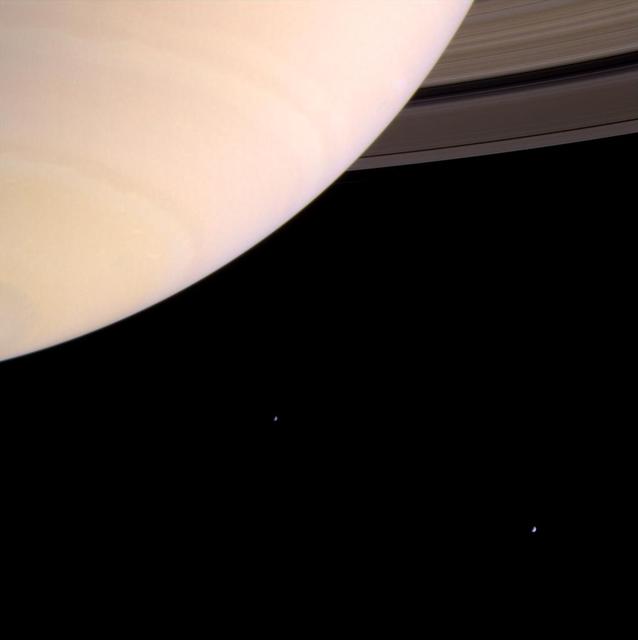
Ver en NASA ↗Saturn second largest moon Rhea pops in and out of view behind the planet rings in this image from NASA Cassini spacecraft, which includes the smaller moon Epimetheus.
Ver en NASA ↗Vertical structures in the variable outer edge of Saturn B ring cast shadows in these two images captured by NASA Cassini spacecraft shortly after the planet August 2009 northern vernal equinox.
Ver en NASA ↗Saturn rings appear curved in this view from NASA Cassini spacecraft, which also shows the moon Janus in the distance. Janus is at the bottom of the image and is farther from the spacecraft than the rings are.
Ver en NASA ↗The recently formed south polar vortex stands out in the color-swaddled atmosphere of Saturn largest moon, Titan, in this natural color view from NASA Cassini spacecraft.
Ver en NASA ↗Contenido y metadatos proporcionados por la NASA Image and Video Library.