







/NASA’s%20Artemis%20III%20Announcement%20(Official%20NASA%20Trailer)~thumb.jpg)

NASA Cassini spacecraft captured Saturn B ring showing off bright spokes in the middle of this image taken at high phase in visible light with the narrow-angle camera.
Ver en NASA ↗🚀 Biblioteca espacial oficial
Imágenes y vídeos de NASA
Explora el catálogo multimedia público de NASA sin salir de TuPortalNews.
Explora temas destacados
Selecciona un tema o realiza una búsqueda personalizada.
4.237 resultados en NASA
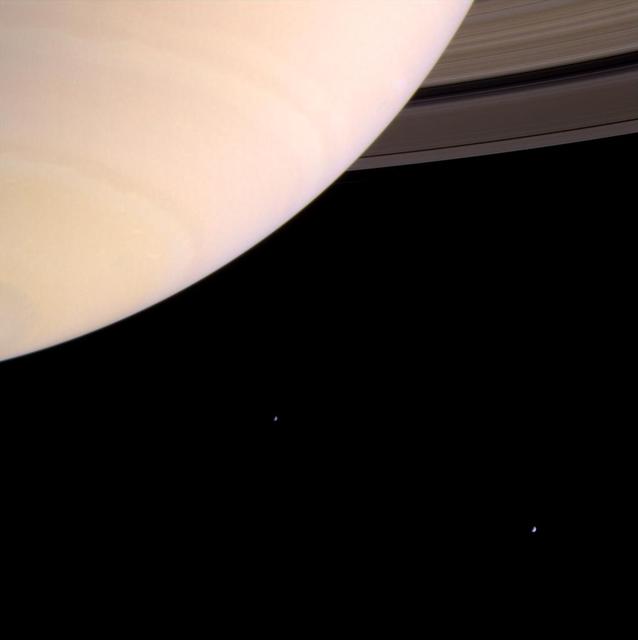
Saturn moon Rhea is gently lit in front of a background of the planet with a wide shadow cast by the rings which are seen nearly edge-on in this image captured by NASA Cassini spacecraft.
Ver en NASA ↗NASA Cassini spacecraft captures Saturn moon Rhea at crescent phase, a view never visible from Earth. Near the terminator, a few of Rhea many craters show up in sharp relief.
Ver en NASA ↗Saturn rings and its moon Rhea are imaged before a crescent of the planet in this image captured by NASA Cassini spacecraft. The shadows of the rings continue to grow wider after their disappearing act during the planet August 2009 equinox.
Ver en NASA ↗A gaggle of moons parade around Saturn rings in this image from NASA Cassini spacecraft in which the large moon Rhea passes in front of the small moon Janus. Go to the Photojournal to view the animation.
Ver en NASA ↗After nearly three years at Saturn, the Cassini spacecraft continues to observe the planet retinue of icy moons. Rhea cratered face attests to its great age, while its bright wisps hint at tectonic activity in the past
Ver en NASA ↗While the moon Epimetheus passes by, beyond the edge of Saturn main rings, the tiny moon Daphnis carries on its orbit within the Keeler gap of the A ring in this image from NASA Cassini spacecraft.
Ver en NASA ↗Long shadows stretch away from the towering edge waves created by the gravity of the moon Daphnis in this image taken by NASA Cassini spacecraft a little more than a week before Saturn August 2009 equinox.
Ver en NASA ↗A brilliant spot of sunlight, the opposition effect, travels outward across the rings as the Cassini spacecraft orbits Saturn. This surge in ring brightness is created around the point directly opposite the Sun from the spacecraft
Ver en NASA ↗Alternating light and dark bands, extending a great distance across Saturn’s D and C rings taken by NASA Cassini spacecraft one month before the planet’s August 2009 equinox.
Ver en NASA ↗Three new small lakes, 100 to 300 square miles a few hundreds of square kilometers in surface area, have been identified on Saturn moon Titan in data from NASA Cassini spacecraft.
Ver en NASA ↗Sunlight passing through the Cassini Division between Saturn A and B rings sweeps across and illuminates the surface of the moon Janus in this image captured by NASA Cassini spacecraft. Go to the Photojournal to view the animation.
Ver en NASA ↗This enhanced-color view of Saturn moon Mimas was made from images obtained by NASA Cassini spacecraft. It highlights the bluish band around the icy moon equator. The large round gouge on the surface is Herschel Crater.
Ver en NASA ↗NASA Cassini spacecraft obtained this view of the south polar area of Saturn moon Enceladus in visible and near-visible ultraviolet and infrared light and synthetic-aperture radar SAR.
Ver en NASA ↗The famed wispy terrain on Saturn moon Dione is front and center in this recent image captured by NASA Cassini spacecraft. The wisps are fresh fractures on the trailing hemisphere of the moon icy surface.
Ver en NASA ↗This mosaic, part of a larger mosaic of images captured by NASA Cassini Orbiter just hours before exact equinox at Saturn, shows that the spiral corrugation in the planet’s inner rings continues right up to the inner B ring.
Ver en NASA ↗Hemispheric color differences on Saturn moon Rhea are apparent in this false-color view from NASA Cassini spacecraft. This image shows the side of the moon that always faces the planet.
Ver en NASA ↗The image on the left shows Cassini view on approach to Phoebe, while the right shows the spacecraft departing perspective. As it entered the Saturn system, NASA Cassini spacecraft performed its first targeted flyby of one of the planet moons.
Ver en NASA ↗Bright spokes grace the B ring in this image which also includes the shadow of the moon Mimas and was taken by NASA Cassini spacecraft about a month after Saturn August 2009 equinox.
Ver en NASA ↗This mosaic shows an updated global map of Saturn icy moon Enceladus, created using images taken during flybys of NASA Cassini spacecraft. The map incorporates new images taken during flybys in December 2011.
Ver en NASA ↗This high-resolution stereo anaglyph captured by NASA Cassini spacecraft of Saturn moon Enceladus shows a region of craters softened by time and torn apart by tectonic stresses. 3D glasses are necessary to view this image.
Ver en NASA ↗This series of false-color images obtained by NASA Cassini spacecraft shows the dissolving cloud cover over the north pole of Saturn moon Titan, allowing scientists to see the underlying northern lakes and seas, including Kraken Mare.
Ver en NASA ↗Epimetheus, seen here by NASA Cassini spacecraft, with Saturn in the background, is lumpy and misshapen, thanks in part to its size and formation process. Bombardment over the eons has left this tiny moon surface heavily pitted.
Ver en NASA ↗Two different instruments on NASA Cassini spacecraft combined their observations to create a more detailed portrait of the Hotei Regio area on Saturn moon Titan. Blue lines on top show the location of channels that stand out in the bottom of image.
Ver en NASA ↗Contenido y metadatos proporcionados por la NASA Image and Video Library.