






/NASA’s%20Artemis%20III%20Announcement%20(Official%20NASA%20Trailer)~thumb.jpg)

This image shows an updated map of Saturn icy moon Enceladus, generated by NASA Cassini imaging team. The map incorporates new images taken in 2008, with better image processing techniques.
Ver en NASA ↗🚀 Biblioteca espacial oficial
Imágenes y vídeos de NASA
Explora el catálogo multimedia público de NASA sin salir de TuPortalNews.
Explora temas destacados
Selecciona un tema o realiza una búsqueda personalizada.
4.237 resultados en NASA
Saturn moon Tethys orbits in front of the wide shadows cast by the rings onto the planet for this view from NASA Cassini spacecraft. Tethys appears just below the rings near the center of the image.
Ver en NASA ↗Cassini briefly turned its gaze from Saturn and its rings and moons to marvel at the Carina Nebula, a brilliant region 8,000 light years from our solar system and more than 200 light years across
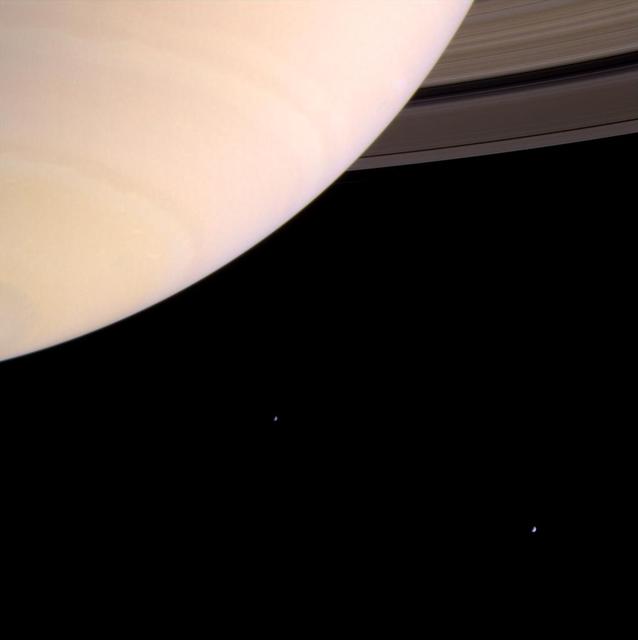
Ver en NASA ↗Saturn moon Epimetheus casts a shadow across colorful rings in this image taken by NASA Cassini spacecraft before the planet August 2009 equinox. Epimetheus is visible as a small dot at the center of the bottom of the image.
Ver en NASA ↗This image taken by NASA Cassini spacecraft shows that rather than being an unchanging disk of peaceful particles, the material that makes up Saturn rings is constantly pushed and pulled into spectacular shapes. At left is the moon Daphnis.
Ver en NASA ↗Saturn rings appear curved in this view from NASA Cassini spacecraft, which also shows the moon Janus in the distance. Janus is at the bottom of the image and is farther from the spacecraft than the rings are.
Ver en NASA ↗Saturn rings lie between a pair of moons in this view from NASA Cassini spacecraft that features Mimas and Prometheus. Mimas is the more noticeable of the two moons at top left, Prometheus is near the center of image and closest to Cassini.
Ver en NASA ↗Tiny, dust-sized particles in Saturn rings become much easier to see at high phase angle -- the angle formed by the Sun, the rings and the spacecraft. The brightest ring is the F ring; the next feature to the left is the outer edge of the A ring
Ver en NASA ↗In this image taken by NASA Cassini spacecraft, the bright arc in Saturn faint G ring contains a little something special. Although it cant be seen here, the tiny moonlet Aegaeon orbits within the bright arc.
Ver en NASA ↗A group of bright spokes tightly cluster together in Saturn B ring. The spokes seen here generally all exhibit the same degree of shearing, or tilting, but some deviations are apparent
Ver en NASA ↗In their orbital ballet, Janus and Epimetheus swap positions every four years -- one moon moving closer to Saturn, the other moving farther away. The two recently changed positions
Ver en NASA ↗Small water ice particles fly from fissures in the south polar region of Saturn moon Enceladus in this image taken during the Aug. 13, 2010, flyby of the moon by NASA Cassini spacecraft.
Ver en NASA ↗NASA Cassini spacecraft observes three of Saturn moons set against the darkened night side of the planet. Seen here are Rhea, closest to Cassini, Enceladus to right of Rhea, and Dione, left of Rhea.
Ver en NASA ↗Saturn moon Dione coasts along in its orbit appearing in front of its parent planet in this view from NASA Cassini spacecraft. The wispy terrain on the trailing hemisphere of Dione can be seen on the left of the moon here.
Ver en NASA ↗NASA Cassini spacecraft stared toward Saturn two-toned moon Iapetus for about a week in early 2015, in a campaign motivated in part to investigate subtle color differences within the moon bright terrain.
Ver en NASA ↗The spoke-producing region of the B ring displays fine-scale asymmetry in the azimuthal direction -- the direction along which the ring particles orbit Saturn -- from upper left to lower right across the image
Ver en NASA ↗Janus and Epimetheus continue to separate, following their orbital swap in January 2006. Until 2010, Janus will remain the innermost of the pair, whose orbits around Saturn are separated by only about 50 kilometers 31 miles on average
Ver en NASA ↗Dione beautiful wispy terrain is brightly lit alongside Saturn elegant rings in this image captured by NASA Cassini spacecraft. The wisps are relatively young fractures on the trailing hemisphere of Dione icy surface.
Ver en NASA ↗This view from NASA Cassini spacecraft look toward the south polar region of Saturn largest moon, Titan, and show a depression within the moon orange and blue haze layers near the south pole.
Ver en NASA ↗This image from the Radar instrument aboard NASA Cassini spacecraft show the evolution of a transient feature in the large hydrocarbon sea named Ligeia Mare on Saturn moon Titan.
Ver en NASA ↗NASA Cassini spacecraft surveys the surface of Saturn moon Enceladus in this image, which shows newly created terrain in the upper right meeting older, cratered terrain in the lower left.
Ver en NASA ↗Appearing like the swirls of marble, the wispy terrain of Saturn moon Dione is captured by NASA Cassini spacecraft in a dramatic display of light and dark. These wispy features are a system of braided canyons with bright walls.
Ver en NASA ↗NASA Cassini spacecraft takes a close look at a row of craters on Saturn moon Tethys during the spacecraft April 14, 2012, flyby of the moon. Three large craters are visible along the terminator between day and night on Tethys.
Ver en NASA ↗Subtle color differences on Saturn moon Mimas are apparent in this false-color view of Herschel Crater captured during NASA Cassini spacecraft on its closest-ever flyby of that moon.
Ver en NASA ↗Contenido y metadatos proporcionados por la NASA Image and Video Library.