





/NASA’s%20Artemis%20III%20Announcement%20(Official%20NASA%20Trailer)~thumb.jpg)

Islands of older high-standing terrain rise above a sea of relatively young, platy lava flows between two of the largest volcanoes in the solar system in this image from NASA Mars Odyssey spacecraft.
Ver en NASA ↗🚀 Biblioteca espacial oficial
Imágenes y vídeos de NASA
Explora el catálogo multimedia público de NASA sin salir de TuPortalNews.
Explora temas destacados
Selecciona un tema o realiza una búsqueda personalizada.
7.277 resultados en NASA
Images of asteroid 2007 PA8 have been generated with data collected by NASA Goldstone Solar System Radar. The images of 2007 PA8 reveal possible craters, boulders, an irregular, asymmetric shape, and very slow rotation.
Ver en NASA ↗After journeying a bit more than an hour across the Solar System, bright sunlight reflects off the gleaming icy cliffs in the wispy terrain of Dione and is captured by NASA Cassini spacecraft cameras several light seconds later
Ver en NASA ↗NASA Cassini spacecraft captured the first lightning flashes on Saturn. The storm that generated the lightning lasted from January to October 2009, making it the longest-lasting lightning storm known in the solar system.
Ver en NASA ↗This artist concept shows NASA Voyager 1 spacecraft in a new region at the edge of our solar system where the magnetic field lines generated by our sun are piling up and intensifying.
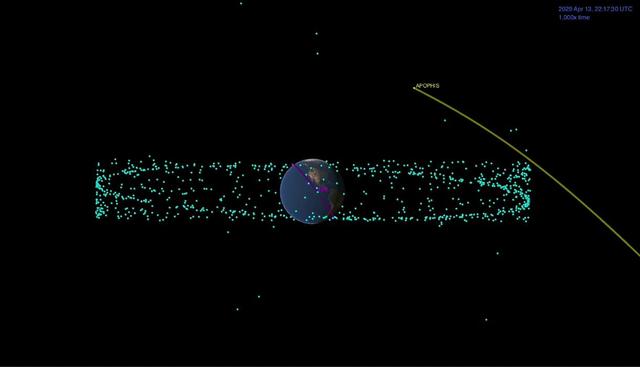
Ver en NASA ↗Artist's illustration of the trajectory of asteroid 2017 YE5 through the solar system. At its closest approach to Earth, the asteroid came to within 16 times the distance between Earth and the moon.
Ver en NASA ↗These time-lapse images of a newfound dwarf planet in our solar system, formerly known as 2003 UB313 or Xena, and now called Eris, were taken using the Samuel Oschin Telescope at the Palomar Observatory.
Ver en NASA ↗Like drippings from a candle, these lava flows on the flank of Olympus Mons volcano, seen in this image from NASA Mars Odyssey spacecraft, demonstrate how it became the largest volcano in the solar system.
Ver en NASA ↗This artist concept shows NASA Voyager 1 spacecraft in a new region at the edge of our solar system where the magnetic field lines generated by our sun are piling up and intensifying.
Ver en NASA ↗Using data from NASA Kepler and Spitzer Space Telescopes, scientists have made the most precise measurement ever of the size of a world outside our solar system, as illustrated in this artist conception.
Ver en NASA ↗This artist concept shows NASA Dawn spacecraft heading toward the dwarf planet Ceres. When Dawn arrives, it will be the first spacecraft to go into orbit around two destinations in our solar system beyond Earth.
Ver en NASA ↗NASA Cassini spacecraft captures a still and partially sunlit Enceladus. The Saturnian moon is covered in ice that reflects sunlight similar to freshly fallen snow, making Enceladus one of the most reflective objects in the solar system.
Ver en NASA ↗This anaglyph from NASA Mars Reconnaissance Orbiter spacecraft, shows Olympus Mons, the largest volcano in the Solar System. Constructed of lava flows, many aspects of this titanic volcano remain puzzling. 3D glasses are necessary to view this image.
Ver en NASA ↗This digital collage contains a highly stylized rendition of our solar system and points beyond. As this graphic was intended to be used as a navigation aid in searching for data within the Photojournal, certain artistic embellishments have been added.
Ver en NASA ↗This Aug. 29, 2013, outburst on Io was among the largest ever observed on the most volcanically active body in the solar system. The infrared was image taken by Gemini North telescope.
Ver en NASA ↗Melas Chasma is the widest segment of Valles Marineris, the largest canyon in the Solar System as seen by Mars Reconnaissance Orbiter spacecraft. In this region, hydrated sulfate salts have been detected.
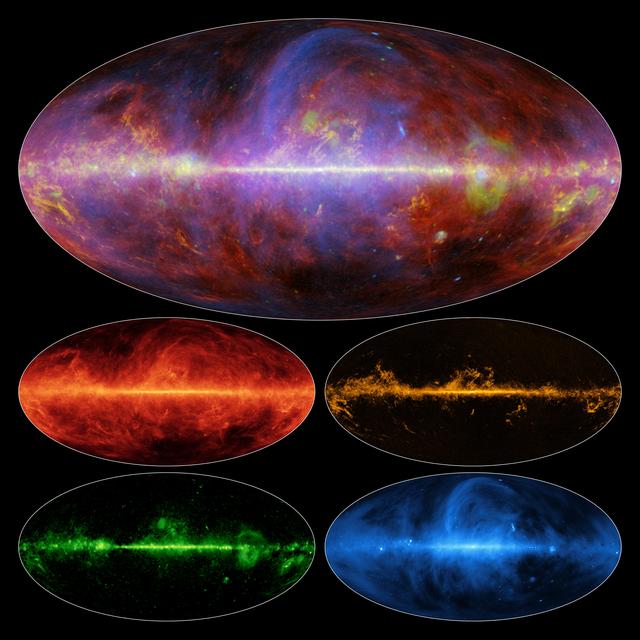
Ver en NASA ↗New data from NASA Cassini spacecraft suggest that the shape of our solar system moving through the local Milky Way galaxy looks like a bubble -- or a rat -- traveling through a boa constrictor belly.
Ver en NASA ↗Saturn moon Enceladus reflects sunlight brightly while the planet and its rings fill the background in this view from NASA Cassini spacecraft. Enceladus is one of the most reflective bodies in the solar system.
Ver en NASA ↗Intriguing patterns of unknown origin appeared on the surface of Neptune largest satellite, Triton, in this image returned by NASA Voyager 2 on Aug. 22, 1989. Voyager images showed that Triton is one of the brightest objects in the solar system,
Ver en NASA ↗As seen by NASA Cassini spacecraft, the surface of Dione is covered in craters, reminding us of the impacts that have shaped all of the worlds of our solar system; the surface also bears linear features that suggest geological activity in the past.
Ver en NASA ↗This image shows an orbital view sweeping upward from Olympus Mons, the tallest volcano in the solar system, to the location of NASA Phoenix Mars Lander in the northern polar reaches of Mars.
Ver en NASA ↗This artist concept shows a Super Venus planet on the left, and a Super Earth on the right. Researchers use a concept known as the habitable zone to distinguish between these two types of planets, which exist beyond our solar system.
Ver en NASA ↗Artist rendering of NASA Stardust capsule returning to Earth. The Stardust spacecraft will bring back samples of interstellar dust, including recently discovered dust streaming into our Solar System from the direction of Sagittarius.
Ver en NASA ↗Researchers have detected the first exomoon candidate -- a moon orbiting a planet that lies outside our solar system. Using a technique called microlensing, they observed what could be either a moon and a planet -- or a planet and a star.
Ver en NASA ↗Contenido y metadatos proporcionados por la NASA Image and Video Library.