





/NASA’s%20Artemis%20III%20Announcement%20(Official%20NASA%20Trailer)~thumb.jpg)

S71-17620 (31 Jan. 1971) --- The huge, 363-feet tall Apollo 14 (Spacecraft 110/Lunar Module 8/Saturn 509) space vehicle is launched from Pad A, Launch Complex 39, Kennedy Space Center, Florida, at 4:03:02 p.m. (EST), Jan. 31, 1981, on a lunar landing mission.…
Ver en NASA ↗🚀 Biblioteca espacial oficial
Imágenes y vídeos de NASA
Explora el catálogo multimedia público de NASA sin salir de TuPortalNews.
Explora temas destacados
Selecciona un tema o realiza una búsqueda personalizada.
4.237 resultados en NASA
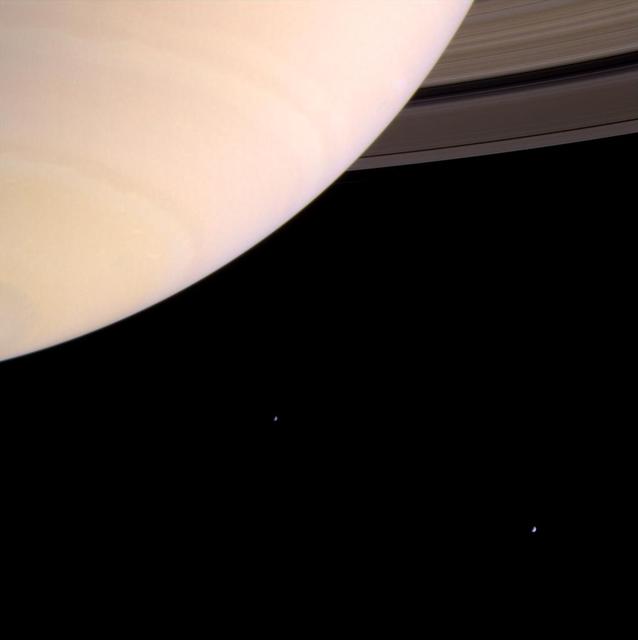
Saturn C ring isnt uniformly bright. Instead, about a dozen regions of the ring stand out as noticeably brighter than the rest of the ring, as shown here by NASA's Cassini spacecraft.
Ver en NASA ↗This view from NASA's Cassini spacecraft showcases some of the amazingly detailed structure of Saturn rings. The image was taken in visible light with the Cassini spacecraft wide-angle camera on Sept. 24, 2016.
Ver en NASA ↗When seen up close, the F ring of Saturn resolves into multiple dusty strands. NASA's Cassini spacecraft view shows three bright strands and a very faint fourth strand off to the right.
Ver en NASA ↗In 1973, Skylab, America's first space station, was launched aboard a two-stage Saturn V vehicle. Saturn IB rockets were used to launch three different three-man crews to the Skylab space station.
Ver en NASA ↗This image obtained by NASA Cassini spacecraft of the outer edge of Saturn?s B ring, reveals the combined effects of a tugging moon and oscillations that can naturally occur in disks like Saturn rings and spiral galaxies.
Ver en NASA ↗Artist: unknown (JPL) Saturn Voyager Mission Artwork depicts the spacecraft's path on it's journey to Saturn as it passed above the orbits of Mercury, Venus, Earth, Mars and around Jupiter.
Ver en NASA ↗The Voyager 2 aboard Titan III-Centaur launch vehicle lifted off on August 20, 1977. The Voyager 2 was a scientific satellite to study the Jupiter and the Saturn planetary systems including their satellites and Saturn's rings.
Ver en NASA ↗Artist: unknown (JPL) Saturn Voyager Mission Artwork depicts the spacecraft's path on it's journey to Saturn as it passed above the orbits of Mercury, Venus, Earth, Mars and around Jupiter.
Ver en NASA ↗In 1973, Skylab, America's first space station, was launched aboard a two-stage Saturn V vehicle. Saturn IB rockets were used to launch three different three-man crews to the Skylab space station.
Ver en NASA ↗At its founding, the Marshall Space Flight Center (MSFC) inherited the Army’s Jupiter and Redstone test stands, but much larger facilities were needed for the giant stages of the Saturn V. From 1960 to 1964, the existing stands were remodeled and a sizable ne…
Ver en NASA ↗At its founding, the Marshall Space Flight Center (MSFC) inherited the Army’s Jupiter and Redstone test stands, but much larger facilities were needed for the giant stages of the Saturn V. From 1960 to 1964, the existing stands were remodeled and a sizable ne…
Ver en NASA ↗At its founding, the Marshall Space Flight Center (MSFC) inherited the Army’s Jupiter and Redstone test stands, but much larger facilities were needed for the giant stages of the Saturn V. From 1960 to 1964, the existing stands were remodeled and a sizable ne…
Ver en NASA ↗At its founding, the Marshall Space Flight Center (MSFC) inherited the Army’s Jupiter and Redstone test stands, but much larger facilities were needed for the giant stages of the Saturn V. From 1960 to 1964, the existing stands were remodeled and a sizable ne…
Ver en NASA ↗At its founding, the Marshall Space Flight Center (MSFC) inherited the Army’s Jupiter and Redstone test stands, but much larger facilities were needed for the giant stages of the Saturn V. From 1960 to 1964, the existing stands were remodeled and a sizable ne…
Ver en NASA ↗At its founding, the Marshall Space Flight Center (MSFC) inherited the Army’s Jupiter and Redstone test stands, but much larger facilities were needed for the giant stages of the Saturn V. From 1960 to 1964, the existing stands were remodeled and a sizable ne…
Ver en NASA ↗At its founding, the Marshall Space Flight Center (MSFC) inherited the Army’s Jupiter and Redstone test stands, but much larger facilities were needed for the giant stages of the Saturn V. From 1960 to 1964, the existing stands were remodeled and a sizable ne…
Ver en NASA ↗At its founding, the Marshall Space Flight Center (MSFC) inherited the Army’s Jupiter and Redstone test stands, but much larger facilities were needed for the giant stages of the Saturn V. From 1960 to 1964, the existing stands were remodeled and a sizable ne…
Ver en NASA ↗At its founding, the Marshall Space Flight Center (MSFC) inherited the Army’s Jupiter and Redstone test stands, but much larger facilities were needed for the giant stages of the Saturn V. From 1960 to 1964, the existing stands were remodeled and a sizable ne…
Ver en NASA ↗At its founding, the Marshall Space Flight Center (MSFC) inherited the Army’s Jupiter and Redstone test stands, but much larger facilities were needed for the giant stages of the Saturn V. From 1960 to 1964, the existing stands were remodeled and a sizable ne…
Ver en NASA ↗At its founding, the Marshall Space Flight Center (MSFC) inherited the Army’s Jupiter and Redstone test stands, but much larger facilities were needed for the giant stages of the Saturn V. From 1960 to 1964, the existing stands were remodeled and a sizable ne…
Ver en NASA ↗At its founding, the Marshall Space Flight Center (MSFC) inherited the Army’s Jupiter and Redstone test stands, but much larger facilities were needed for the giant stages of the Saturn V. From 1960 to 1964, the existing stands were remodeled and a sizable ne…
Ver en NASA ↗At its founding, the Marshall Space Flight Center (MSFC) inherited the Army’s Jupiter and Redstone test stands, but much larger facilities were needed for the giant stages of the Saturn V. From 1960 to 1964, the existing stands were remodeled and a sizable ne…
Ver en NASA ↗At its founding, the Marshall Space Flight Center (MSFC) inherited the Army’s Jupiter and Redstone test stands, but much larger facilities were needed for the giant stages of the Saturn V. From 1960 to 1964, the existing stands were remodeled and a sizable ne…
Ver en NASA ↗Contenido y metadatos proporcionados por la NASA Image and Video Library.