






/NASA’s%20Artemis%20III%20Announcement%20(Official%20NASA%20Trailer)~thumb.jpg)

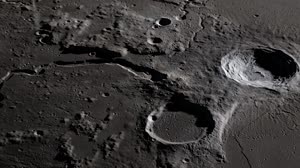
NASA Cassini spacecraft takes a detailed look at the northern part of the huge Odysseus Crater on Saturn moon Tethys. The crater dominates the left half of this view of Tethys.
Ver en NASA ↗🚀 Biblioteca espacial oficial
Imágenes y vídeos de NASA
Explora el catálogo multimedia público de NASA sin salir de TuPortalNews.
Explora temas destacados
Selecciona un tema o realiza una búsqueda personalizada.
4.237 resultados en NASA
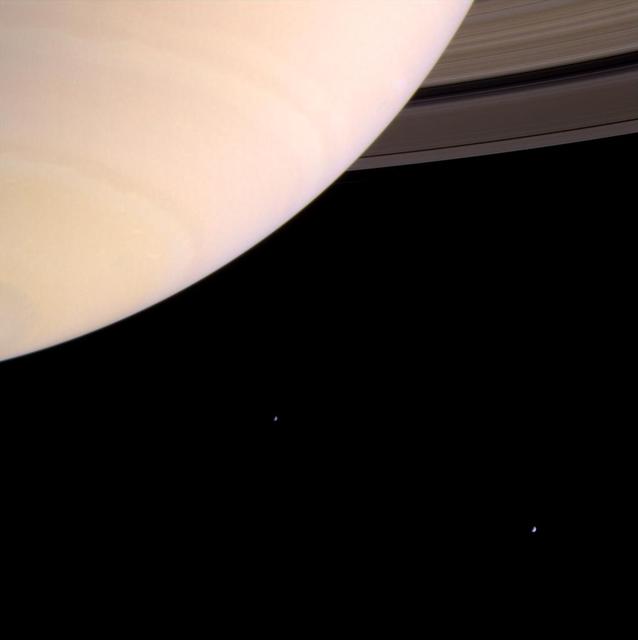
The cratered moon Mimas appears as if it has been hung like an ornament above Saturn rings in this image taken by NASA Cassini spacecraft.
Ver en NASA ↗Six of Saturn moons orbiting within and beyond the planet rings are collected in this Cassini spacecraft image; they include Enceladus, Epimetheus, Atlas, Daphnis, Pan, and Janus.
Ver en NASA ↗This image of Ontario Lacus, the largest lake on the southern hemisphere of Saturn moon Titan, was obtained by NASA Cassini spacecraft. The lake surface appears dark because it is smooth.
Ver en NASA ↗Saturn odd but ever-intriguing F ring displays multiple lanes and several bright clumps. The Keeler and Encke gaps are visible in the outer A ring, at right
Ver en NASA ↗S68-18733 (22 Jan. 1968) --- Dr. Robert R. Gilruth (right), MSC Director, sits with Dr. Christopher C. Kraft Jr., MSC director of flight operations, at his flight operations director console in the Mission Control Center, Building 30, during the Apollo 5 (LM-…
Ver en NASA ↗S69-25879 (23 Feb. 1969) --- Nighttime view of the 363-feet-high Apollo 9 space vehicle at Pad A, Launch Complex 39, Kennedy Space Center, during preparations for the scheduled 10-day Earth-orbital space mission. The crew of the Apollo 9 (Spacecraft 104/Lunar…
Ver en NASA ↗S69-34327 (13 May 1969) --- Aerial, high-angle, view of the Apollo 10 (Spacecraft 106/Lunar Module 4/Saturn 505) space vehicle at Pad B, Launch Complex 39, Kennedy Space Center, Florida. The crew of the Apollo 10 lunar orbit mission will be astronauts Thomas …
Ver en NASA ↗S71-18395 (31 Jan. 1971) --- The huge, 363-feet tall Apollo 14 (Spacecraft 110/Lunar Module 8/Saturn 509) space vehicle is launched from Pad A, Launch Complex 39, Kennedy Space Center (KSC), Florida at 4:03:02 p.m. (EST), Jan. 31, 1971, on a lunar landing mis…
Ver en NASA ↗This illustration shows NASA's Cassini spacecraft about to make one of its dives between Saturn and its innermost rings as part of the mission Grand Finale.
Ver en NASA ↗At its founding, the Marshall Space Flight Center (MSFC) inherited the Army’s Jupiter and Redstone test stands, but much larger facilities were needed for the giant stages of the Saturn V. From 1960 to 1964, the existing stands were remodeled and a sizable ne…
Ver en NASA ↗At its founding, the Marshall Space Flight Center (MSFC) inherited the Army’s Jupiter and Redstone test stands, but much larger facilities were needed for the giant stages of the Saturn V. From 1960 to 1964, the existing stands were remodeled and a sizable ne…
Ver en NASA ↗At its founding, the Marshall Space Flight Center (MSFC) inherited the Army’s Jupiter and Redstone test stands, but much larger facilities were needed for the giant stages of the Saturn V. From 1960 to 1964, the existing stands were remodeled and a sizable ne…
Ver en NASA ↗At its founding, the Marshall Space Flight Center (MSFC) inherited the Army’s Jupiter and Redstone test stands, but much larger facilities were needed for the giant stages of the Saturn V. From 1960 to 1964, the existing stands were remodeled and a sizable ne…
Ver en NASA ↗At its founding, the Marshall Space Flight Center (MSFC) inherited the Army’s Jupiter and Redstone test stands, but much larger facilities were needed for the giant stages of the Saturn V. From 1960 to 1964, the existing stands were remodeled and a sizable ne…
Ver en NASA ↗At its founding, the Marshall Space Flight Center (MSFC) inherited the Army’s Jupiter and Redstone test stands, but much larger facilities were needed for the giant stages of the Saturn V. From 1960 to 1964, the existing stands were remodeled and a sizable ne…
Ver en NASA ↗At its founding, the Marshall Space Flight Center (MSFC) inherited the Army’s Jupiter and Redstone test stands, but much larger facilities were needed for the giant stages of the Saturn V. From 1960 to 1964, the existing stands were remodeled and a sizable ne…
Ver en NASA ↗Voyager Saturn Mission Artwork (Mariner - Jupiter - Saturn - Uranus) show slingshot technique
Ver en NASA ↗This montage of images of the planets visited by Voyager 2 was prepared from an assemblage of images taken in 1980 by NASA's Voyager 2 spacecraft.
Ver en NASA ↗Lonely Mimas swings around Saturn, seeming to gaze down at the planet's splendid rings, as shown in this image from NASA's Cassini spacecraft.
Ver en NASA ↗The shadow of Saturn on the rings, which stretched across all of the rings earlier in NASA's Cassini mission, now barely makes it past the Cassini division.
Ver en NASA ↗It may look as though Saturn moon Mimas is crashing through the rings in this image taken by NASA's Cassini spacecraft, but Mimas is actually 28,000 mi 45,000 km away from the rings. There is a strong connection between the icy moon and Saturn rings
Ver en NASA ↗Apollo Spacecraft 104 Command/Service Module and Lunar Module 3 arrive at the Vehicle Assembly Building (VAB) for mating atop the Saturn 504 launch vehicle. The Saturn 504 stack is out of view. The Saturn V first (S-IC) stage in left background is scheduled f…
Ver en NASA ↗S68-29781 (22 April 1968) --- Low angle view at the Kennedy Space Center's Pad 34 showing the erection of the first stage of the Saturn 205 launch vehicle. The two-stage Saturn IB will be the launch vehicle for the first unmanned Apollo space mission, Apollo …
Ver en NASA ↗Contenido y metadatos proporcionados por la NASA Image and Video Library.