






/NASA’s%20Artemis%20III%20Announcement%20(Official%20NASA%20Trailer)~thumb.jpg)

Clouds move above the large methane lakes and seas near the north pole of Saturn moon Titan in this image taken by NASA Cassini spacecraft.
Ver en NASA ↗🚀 Biblioteca espacial oficial
Imágenes y vídeos de NASA
Explora el catálogo multimedia público de NASA sin salir de TuPortalNews.
Explora temas destacados
Selecciona un tema o realiza una búsqueda personalizada.
4.237 resultados en NASA
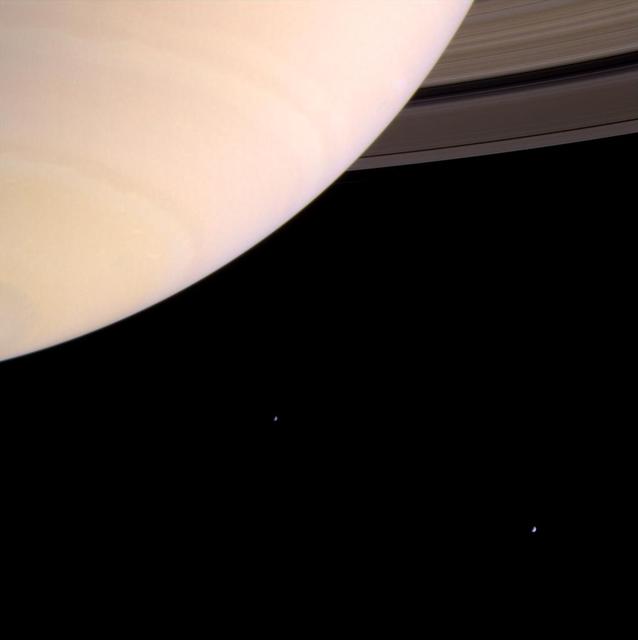
Saturn moon Enceladus is partially eclipsed by the planet in this view from NASA Cassini spacecraft which also features the moon Titan in the distance.
Ver en NASA ↗Geologic faults among craters on Saturn moon Tethys are depicted in this image captured during a flyby of the moon by NASA Cassini spacecraft on Aug. 14, 2010.
Ver en NASA ↗A wide shadow is cast onto the thin F ring and the A ring by the moon Janus in this image taken as Saturn approached its August 2009 equinox.
Ver en NASA ↗NASA Cassini spacecraft captured this high-resolution view of the cratered surface of Saturn moon Rhea as the spacecraft flew by the moon on Oct. 17, 2010.
Ver en NASA ↗A seven-year journey to the ringed planet Saturn begins with the liftoff of a Titan IVB/Centaur carrying NASA Cassini orbiter and its attached Huygens probe.
Ver en NASA ↗Although travelling at great speed, NASA Cassini spacecraft managed to capture this close view of Saturn small moon Helene during a flyby on March 3, 2010.
Ver en NASA ↗The shadow of Saturn largest moon darkens a huge portion of the gas giant planet. Titan is not pictured here, but its shadow is elongated in the bottom right of the image.
Ver en NASA ↗Saturn small, potato-shaped moon Prometheus orbits between the main rings and the thin F ring in this view captured by NASA Cassini spacecraft.
Ver en NASA ↗These two images, taken about eight minutes apart, show clump-like structures and a great deal of dust in Saturn ever-changing F ring
Ver en NASA ↗This image shows a pair of moons, Pandora and Prometheus, continuing their shepherding duties near Saturn thin F ring as seen by NASA Cassini spacecraft.
Ver en NASA ↗The right-hand limb of Saturn moon Mimas appears flattened as Herschel Crater is viewed edge-on in this image from NASA Cassini spacecraft. The planet rings are in the background.
Ver en NASA ↗NASA Cassini spacecraft looks past Saturn rings and small moon Janus to spy the planet second largest moon, Rhea where lit terrain is seen.
Ver en NASA ↗Almost all of the hydrocarbon seas and lakes on the surface of Saturn moon Titan cluster around the north pole, as can be seen in this mosaic from NASA Cassini mission.
Ver en NASA ↗Saturn moon Dione passes by the moon Tethys in this NASA Cassini spacecraft depiction of a mutual event in which one moon passes close to or in front of another moon.
Ver en NASA ↗Distant Titan, its northern hemisphere drenched in the sunlight of late spring, hangs above Saturn rings in this image captured by NASA Cassini spacecraft.
Ver en NASA ↗The bright streaks visible in these Cassini images taken during Saturn’s August 2009 equinox are exciting evidence of a constant rain of interplanetary projectiles onto the planet’s rings.
Ver en NASA ↗NASA Cassini spacecraft examines the characteristics of Titan atmosphere as it peers at Saturn largest moon using a filter sensitive to visible violet light.
Ver en NASA ↗This strikingly crisp view shows Atlas heading into Saturn shadow at upper left. The moon basic, elongated shape is easy to detect here
Ver en NASA ↗Two bright vortices roll across the cloud-lined face of Saturn, where winds howl at high speeds never experienced on Earth
Ver en NASA ↗Craters imprinted upon other craters record the long history of impacts endured by Saturn moon Rhea; this image was taken by NASA Cassini spacecraft.
Ver en NASA ↗This image using synthetic-aperture radar SAR data acquired by NASA Cassini spacecraft shows grooves in the southern part of Saturn moon Enceladus.
Ver en NASA ↗The sponge-like surface of Saturn moon Hyperion is highlighted in this portrait from NASA Cassini spacecraft, captured during the spacecraft flyby on Sept. 16, 2011.
Ver en NASA ↗Saturn entire main ring system spreads out below Cassini in this night side view, which shows the rings disappearing into the planet shadow
Ver en NASA ↗Contenido y metadatos proporcionados por la NASA Image and Video Library.