






/NASA’s%20Artemis%20III%20Announcement%20(Official%20NASA%20Trailer)~thumb.jpg)

Below a darkened Enceladus, a plume of water ice is backlit in this view of one of Saturn most dramatic moons. This image was captured by NASA Cassini spacecraft.
Ver en NASA ↗🚀 Biblioteca espacial oficial
Imágenes y vídeos de NASA
Explora el catálogo multimedia público de NASA sin salir de TuPortalNews.
Explora temas destacados
Selecciona un tema o realiza una búsqueda personalizada.
4.237 resultados en NASA
This view, acquired by NASA Cassini spacecraft, looks toward the unilluminated side of Saturn rings from about 47 degrees below the ringplane.
Ver en NASA ↗The rings of Saturn glow softly as sunlight from below wends its way through. Some of the Sun light bounces off the rings opposite side
Ver en NASA ↗Saturn tiny moon Atlas, just to the left of the center of the image, appears almost indistinguishable from the background stars seen in this image captured by NASA Cassini spacecraft.
Ver en NASA ↗The small moon Pan casts a short shadow on Saturn A ring in this image taken by NASA Cassini spacecraft as the planet approached its August 2009 equinox.
Ver en NASA ↗NASA Cassini spacecraft camera looks in near-infrared light at a dramatic view of Saturn, its ringplane and the shadows of a couple of its moons.
Ver en NASA ↗NASA Cassini spacecraft takes a look through the atmosphere of Saturn largest moon to spy light and dark in the area called Adiri on Titan.
Ver en NASA ↗NASA Cassini spacecraft looks at Saturn highly irregular moon Hyperion in this view from the spacecraft flyby of the moon on Aug. 25, 2011.
Ver en NASA ↗Although the sun is on the other side of Saturn in this dramatic image, some sunlight scatters through the uppermost part of the atmosphere to reach NASA Cassini spacecraft cameras.
Ver en NASA ↗The Cassini spacecraft looks toward daybreak on Saturn through the delicate strands of the C ring. Some structure and contrast is visible in the clouds far below
Ver en NASA ↗Several sets of shadows are cast onto the A ring in this image taken by NASA Cassini Orbiter about a week after Saturn’s August 2009 equinox.
Ver en NASA ↗Flying past Saturn moon Dione, NASA Cassini captured this view which includes two smaller moons, Epimetheus and Prometheus, near the planet rings.
Ver en NASA ↗Thin lineaments cross back and forth, intersecting craters on the surface of Saturn moon Rhea in this equatorial view captured by NASA Cassini spacecraft.
Ver en NASA ↗This global map of Saturn moon Mimas was created using images taken during NASA Cassini spacecraft flybys, with Voyager images filling in the gaps in Cassini coverage.
Ver en NASA ↗Cassini whizzed past Dione on Aug. 16, 2006, capturing this slightly motion-blurred view of the moon fractured and broken landscape in reflected light from Saturn
Ver en NASA ↗Rhea trailing hemisphere shows off its wispy terrain on the left of this image taken by NASA Cassini spacecraft which includes Saturn rings in the distance.
Ver en NASA ↗As Enceladus spews water ice from its south polar region, NASA Cassini also shows Saturn faint G ring before the moon.
Ver en NASA ↗The two large craters on the right of this image are overprinted with smaller, more recent craters of Saturn moon Rhea in this view from NASA Cassini spacecraft.
Ver en NASA ↗The Cassini spacecraft looks down on Titan north pole and unveils the moon upper-most atmospheric hazes, creating the appearance of a halo around Saturn largest moon.
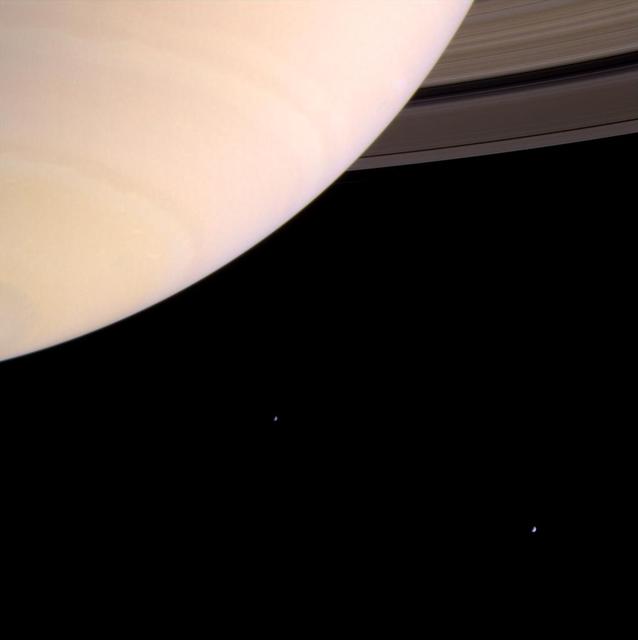
Ver en NASA ↗Tethys may not be tiny by normal standards, but when it is captured alongside Saturn, it cant help but seem pretty small in this image from NASA Cassini spacecraft.
Ver en NASA ↗The propeller-shaped white dashes near the bottom of NASA Cassini spacecraft image reveal the location of a small moonlet embedded in Saturn A ring.
Ver en NASA ↗NASA Cassini spacecraft captured this view of Saturn moon Enceladus that shows wrinkled plains that are remarkably youthful in appearance, being generally free of large impact craters.
Ver en NASA ↗The northern hemisphere of Saturn moon Rhea is seen in this polar stereographic map, mosaicked from the best-available images obtained by NASA Cassini and Voyager spacecraft.
Ver en NASA ↗NASA Cassini spacecraft captures the shadow of Saturn moon Mimas as it dips onto the planet rings and straddles the Cassini Division in this natural color image.
Ver en NASA ↗Contenido y metadatos proporcionados por la NASA Image and Video Library.