






/NASA’s%20Artemis%20III%20Announcement%20(Official%20NASA%20Trailer)~thumb.jpg)

NASA Cassini spacecraft looks toward the south pole of Enceladus, with a glimpse of Saturns rings in the distance, during the spacecrafts close flyby Nov. 2, 2009.
Ver en NASA ↗🚀 Biblioteca espacial oficial
Imágenes y vídeos de NASA
Explora el catálogo multimedia público de NASA sin salir de TuPortalNews.
Explora temas destacados
Selecciona un tema o realiza una búsqueda personalizada.
4.237 resultados en NASA
A giant of a moon appears before a giant of a planet undergoing seasonal changes in this natural color view of Titan and Saturn from NASA Cassini spacecraft.
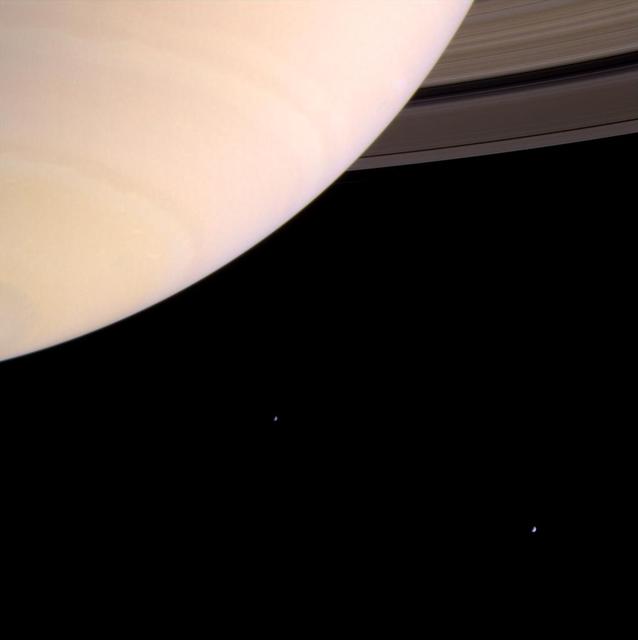
Ver en NASA ↗Shadow-striped Saturn and its exquisitely thin rings occupy the near field in this Cassini spacecraft view, while a crescent Rhea hangs in the distance
Ver en NASA ↗This Cassini spacecraft view shows details of Saturn outer A ring, including the Encke and Keeler gaps. The A ring brightens substantially outside the Keeler Gap
Ver en NASA ↗Saturn small moon Pan, brightly overexposed, casts a short shadow on the A ring in this image taken by NASA Cassini spacecraft before the planet August 2009 equinox.
Ver en NASA ↗Vertical ring structures created by the moon Daphnis cast dark shadows on Saturn A ring in this image taken as the planet approached its August 2009 equinox.
Ver en NASA ↗Three of Saturn small moons straddle the rings in this image captured by NASA Cassini spacecraft. From left to right are Pandora, Prometheus and, near the top right, Epimetheus.
Ver en NASA ↗This artist illustration shows the likely interior structure of Saturn moon Titan deduced from gravity field data collected by NASA Cassini spacecraft.
Ver en NASA ↗Saturn wispy moon Dione lies in front of the cratered surface of the moon Tethys, as seen by NASA Cassini spacecraft. Dione is closest to the spacecraft here.
Ver en NASA ↗The colorful globe of Saturn largest moon, Titan, passes in front of the planet and its rings in this true color snapshot from NASA Cassini spacecraft.
Ver en NASA ↗The shadow of the moon Epimetheus is cast onto Saturn rings, striking the outer-most part of the A ring and only just nipping the F ring.
Ver en NASA ↗The northern and southern hemispheres of Saturn moon Mimas are seen in these polar stereographic maps, mosaicked from the best-available NASA Cassini and Voyager images.
Ver en NASA ↗This dramatic view from NASA Cassini spacecraft looks across the region of Enceladus geyser basin and down on the ends of the Baghdad and Damascus fractures that face Saturn.
Ver en NASA ↗The Cassini spacecraft spies an intriguing bright clump in Saturn F ring. Also of interest is the dark gash that appears to cut through the ring immediately below the clump
Ver en NASA ↗Scientists can use images such as this one from NASA Cassini spacecraft to learn more about the nature of the particles that make up Saturn rings.
Ver en NASA ↗NASA Cassini spacecraft snapped this image of Saturn moon Helene while completing the mission second-closest encounter of the moon on June 18, 2011.
Ver en NASA ↗Craters on Saturn moon Pandora exhibit clarity and depth in this anaglyph from NASA Cassini spacecraft. 3D glasses are necessary to view this image.
Ver en NASA ↗Cracks, canyons, craters, and streaks are seen in this image of Saturn icy moon, Dione, taken from Voyager 2 on August 3, 2005.
Ver en NASA ↗Faint, ghostly spokes dapple the dark side of Saturn A ring as the planet shadow makes a sharp diagonal cut across this image from the Cassini spacecraft.
Ver en NASA ↗Saturn moon Janus, its rugged surface shown in shadow and light, passes before the planet rings in this image taken by NASA Cassini spacecraft.
Ver en NASA ↗NASA Cassini spacecraft examines Titan north polar hood, the part of the atmosphere of Saturn largest moon appearing dark at the top of this image.
Ver en NASA ↗Two different instruments aboard NASA Cassini spacecraft combined their observations to create a more detailed portrait of the Hotei Regio area on Saturn moon Titan.
Ver en NASA ↗The disturbance visible at the outer edge of Saturn A ring in this image from NASA Cassini spacecraft could be caused by an object replaying the birth process of icy moons.
Ver en NASA ↗NASA Cassini spacecraft looks past the night side of Saturn, dimly lit on the left of this image by ringshine, for a subtly distorted view of the planet rings.
Ver en NASA ↗Contenido y metadatos proporcionados por la NASA Image and Video Library.