






/NASA’s%20Artemis%20III%20Announcement%20(Official%20NASA%20Trailer)~thumb.jpg)


This set of images from NASA Cassini mission shows how the gravitational pull of Saturn affects the amount of spray coming from jets at the active moon Enceladus.
Ver en NASA ↗🚀 Biblioteca espacial oficial
Imágenes y vídeos de NASA
Explora el catálogo multimedia público de NASA sin salir de TuPortalNews.
Explora temas destacados
Selecciona un tema o realiza una búsqueda personalizada.
4.237 resultados en NASA
The southern hemisphere of Saturn moon Tethys is seen in this updated polar stereographic maps, mosaicked from the best-available images obtained by NASA Cassini spacecraft.
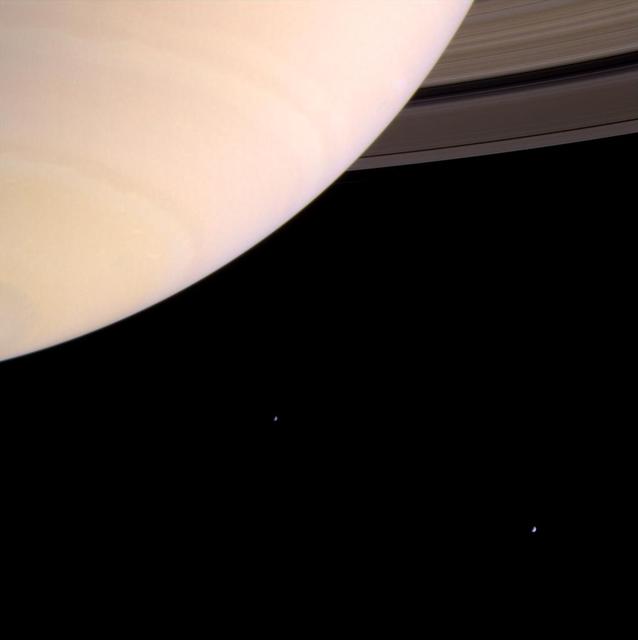
Ver en NASA ↗The dim, unlit side of Saturn rings hides a secret in this view. Shy Mimas can be seen peeking out from behind the rings below center
Ver en NASA ↗Saturn moon Prometheus casts a shadow on the narrow F ring in this image captured by NASA Cassini Orbiter weeks after the planet August 2009 equinox
Ver en NASA ↗Saturn small, irregularly shaped moon Helene is strikingly illuminated in this close view captured by NASA Cassini during the spacecraft June 18, 2011, flyby.
Ver en NASA ↗Images from NASA Cassini spacecraft show changes caused by methane rain in the bright Adiri region near the equator of Saturn largest moon, Titan.
Ver en NASA ↗NASA Cassini spacecraft takes a close view of some of the southern terrain of Saturn moon Enceladus, where newly created terrain is on display.
Ver en NASA ↗Appearing like a freckle on the face of Saturn, a shadow from the moon Enceladus blemishes the planet just below the ringplane in this NASA Cassini spacecraft image.
Ver en NASA ↗A pair of Saturn small satellites, Janus and Pandora, accompany the planet rings in this image from NASA Cassini spacecraft presenting the view in dramatic diagonal fashion.
Ver en NASA ↗A huge impact created Odysseus Crater, which covers a large part of Saturn moon Tethys in this image from NASA Cassini spacecraft.
Ver en NASA ↗NASA Cassini Orbiter caught the shadow of the moon Prometheus as a small dark dot on Saturn just below the narrow shadow cast by the rings in the center of this image.
Ver en NASA ↗This global digital map of Saturn moon Dione was created using data taken by the Cassini spacecraft, with gaps in coverage filled in by NASA Voyager spacecraft data
Ver en NASA ↗This artist conception shows a nearly invisible ring around Saturn -- the largest of the giant planet many rings. It was discovered by NASA Spitzer Space Telescope.
Ver en NASA ↗A small crescent of the moon Rhea is dwarfed by the larger crescent of Saturn in this image captured by NASA Cassini spacecraft. Rhea can be seen in the upper right of the image.
Ver en NASA ↗The strands of Saturn F ring disappear into the darkness of the planet shadow. Background stars make trails across the sky during the long exposure
Ver en NASA ↗The shadow of the moon Tethys stretches across Saturn A ring before fading into the B ring as the shadow extends towards the lower right of this image.
Ver en NASA ↗NASA Cassini spacecraft peers through Titan atmosphere at the region called Adiri, west of the landing site of the Huygens probe on the anti-Saturn side of the moon.
Ver en NASA ↗This global digital map of Saturn moon Enceladus was created using data taken by the Cassini spacecraft, with gaps in coverage filled in by NASA Voyager spacecraft data
Ver en NASA ↗The northern hemisphere of Saturn moon Mimas is seen in these polar stereographic maps, mosaicked from the best-available NASA Cassini and Voyager images.
Ver en NASA ↗Saturn moon Janus casts a shadow on the F and A rings while the moon Prometheus, seen on the left of the image, creates a streamer-channel in the thin F ring.
Ver en NASA ↗A bright clump of material within Saturn tenuous F ring stands out near the center top of this NASA Cassini spacecraft image.
Ver en NASA ↗NASA Cassini spacecraft captured a propeller-shaped disturbance in one of Saturn rings created by a moon that is too small to be seen here. The moon is invisible at the center of the image.
Ver en NASA ↗NASA Cassini spacecraft watches as the shadows of Saturn rings grow wider and creep farther south as the seasons progress from the planet August 2009 equinox.
Ver en NASA ↗Two sources of light reveal the dramatic surface of Saturn moon Enceladus in this NASA Cassini image in which geologic features give the appearance of the leathery skin of an elephant.
Ver en NASA ↗Contenido y metadatos proporcionados por la NASA Image and Video Library.