






/NASA’s%20Artemis%20III%20Announcement%20(Official%20NASA%20Trailer)~thumb.jpg)


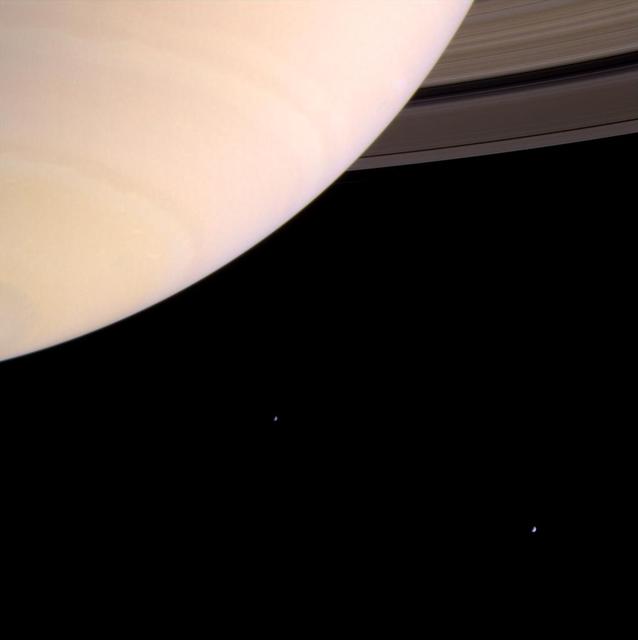
A quartet of Saturn moons are shown with a sliver of the rings in this view from NASA Cassini spacecraft. From left to right in this image are Epimetheus, Janus, Prometheus, and Atlas.
Ver en NASA ↗🚀 Biblioteca espacial oficial
Imágenes y vídeos de NASA
Explora el catálogo multimedia público de NASA sin salir de TuPortalNews.
Explora temas destacados
Selecciona un tema o realiza una búsqueda personalizada.
4.237 resultados en NASA
During a flyby of Saturn moon Enceladus on Oct. 1, 2011, NASA Cassini spacecraft snapped this portrait of the moon joined by its sibling Epimetheus and the planet rings.
Ver en NASA ↗Odysseus Crater, with a size of epic proportions, stretches across a large northern expanse on Saturn moon Tethys in this image taken by NASA Cassini spacecraft.
Ver en NASA ↗A pair of Saturn small, icy satellites accompany the planet rings in snapshot from NASA Cassini spacecraft. The rings are between Janus and Prometheus.
Ver en NASA ↗This contrast-enhanced view shows a faint spoke in Saturn B ring. These ghostly radial structures were imaged by the Voyager spacecraft in the 1980s
Ver en NASA ↗NASA Cassini spacecraft looks toward the night side of Saturn largest moon and sees sunlight scattering through the periphery of Titan atmosphere and forming a ring of color.
Ver en NASA ↗The Cassini spacecraft looks across Saturn cloud-dotted north and shadowed pole, and out across the lanes of ice that compose its rings
Ver en NASA ↗NASA Cassini spacecraft watches over the northern latitudes of Saturn geologically active moon Enceladus while the planet rings peek through in the distance in this snapshot.
Ver en NASA ↗Moon shadows are cast on Saturn A ring in this image taken by NASA Cassini Orbiter almost a month after the planet August 2009 equinox.
Ver en NASA ↗A seven-year journey to the ringed planet Saturn begins with the liftoff of a Titan IVB/Centaur carrying the Cassini orbiter and its attached Huygens probe.
Ver en NASA ↗These two views of Saturn moon Titan show the southern polar vortex, a huge, swirling cloud that was first observed by NASA Cassini spacecraft in 2012.
Ver en NASA ↗The Cassini spacecraft looks at Saturn largest moon, Titan, revealing its halo-like ring formed in the upper hazes of the moon extensive atmosphere.
Ver en NASA ↗The shepherding moon Pandora, near the bottom of the image, casts a shadow on Saturn thin F ring as the planet nears its August 2009 equinox.
Ver en NASA ↗This fortunate view sights along Saturn ringplane to capture three moons aligned in a row: Dione at left, Prometheus at center and Epimetheus at right
Ver en NASA ↗Resembling ornaments hanging from Saturn rings, two moons accent this portrait of the planet captured by NASA Cassini spacecraft. The moon Enceladus is on the right. Dione is on the left.
Ver en NASA ↗The surface of Saturn moon Rhea bears witness to its violent history. Each crater seen here by NASA Cassini spacecraft records an impact in the moon past.
Ver en NASA ↗The line of Saturn rings disrupts NASA Cassini spacecraft view of the moons Tethys and Titan. Larger Titan is on the left. Tethys is near the center of the image.
Ver en NASA ↗Prometheus dips into the inner F ring at its farthest point from Saturn in its orbit, creating a dark gore and a corresponding bright streamer
Ver en NASA ↗The Cassini spacecraft examines the dark region of Senkyo on Saturn largest moon, Titan. Senkyo is in the center of the image, and it lies just south of the moon equator.
Ver en NASA ↗The northern hemisphere of Saturn moon Tethys is seen in this updated polar stereographic map, mosaicked from the best-available images obtained by NASA Cassini spacecraft.
Ver en NASA ↗The Cassini spacecraft current high-inclination orbit allows for some fantastic perspectives, like this shot of Saturn south pole, which looks toward the rings beyond
Ver en NASA ↗This image acquired by NASA Lunar Reconnaissance Orbiter shows a crater center of image formed by impact of the Apollo 14 Saturn IVB booster.
Ver en NASA ↗The shadow of the moon Enceladus darkens a small portion of the swirling clouds on Saturn in this image captured by NASA Cassini spacecraft. Enceladus itself is not visible in this view.
Ver en NASA ↗Atlas can be seen just above the center of this NASA Cassini spacecraft image as the moon orbits in the Roche Division between Saturn A ring and thin F ring.
Ver en NASA ↗Contenido y metadatos proporcionados por la NASA Image and Video Library.