





/NASA’s%20Artemis%20III%20Announcement%20(Official%20NASA%20Trailer)~thumb.jpg)
At its founding, the Marshall Space Flight Center (MSFC) inherited the Army’s Jupiter and Redstone test stands, but much larger facilities were needed for the giant stages of the Saturn V. From 1960 to 1964, the existing stands were remodeled and a sizable ne…
Ver en NASA ↗🚀 Biblioteca espacial oficial
Imágenes y vídeos de NASA
Explora el catálogo multimedia público de NASA sin salir de TuPortalNews.
Explora temas destacados
Selecciona un tema o realiza una búsqueda personalizada.
4.237 resultados en NASA
At its founding, the Marshall Space Flight Center (MSFC) inherited the Army’s Jupiter and Redstone test stands, but much larger facilities were needed for the giant stages of the Saturn V. From 1960 to 1964, the existing stands were remodeled and a sizable ne…
Ver en NASA ↗At its founding, the Marshall Space Flight Center (MSFC) inherited the Army’s Jupiter and Redstone test stands, but much larger facilities were needed for the giant stages of the Saturn V. From 1960 to 1964, the existing stands were remodeled and a sizable ne…
Ver en NASA ↗At its founding, the Marshall Space Flight Center (MSFC) inherited the Army’s Jupiter and Redstone test stands, but much larger facilities were needed for the giant stages of the Saturn V. From 1960 to 1964, the existing stands were remodeled and a sizable ne…
Ver en NASA ↗At its founding, the Marshall Space Flight Center (MSFC) inherited the Army’s Jupiter and Redstone test stands, but much larger facilities were needed for the giant stages of the Saturn V. From 1960 to 1964, the existing stands were remodeled and a sizable ne…
Ver en NASA ↗At its founding, the Marshall Space Flight Center (MSFC) inherited the Army’s Jupiter and Redstone test stands, but much larger facilities were needed for the giant stages of the Saturn V. From 1960 to 1964, the existing stands were remodeled and a sizable ne…
Ver en NASA ↗At its founding, the Marshall Space Flight Center (MSFC) inherited the Army’s Jupiter and Redstone test stands, but much larger facilities were needed for the giant stages of the Saturn V. From 1960 to 1964, the existing stands were remodeled and a sizable ne…
Ver en NASA ↗At its founding, the Marshall Space Flight Center (MSFC) inherited the Army’s Jupiter and Redstone test stands, but much larger facilities were needed for the giant stages of the Saturn V. From 1960 to 1964, the existing stands were remodeled and a sizable ne…
Ver en NASA ↗At its founding, the Marshall Space Flight Center (MSFC) inherited the Army’s Jupiter and Redstone test stands, but much larger facilities were needed for the giant stages of the Saturn V. From 1960 to 1964, the existing stands were remodeled and a sizable ne…
Ver en NASA ↗At its founding, the Marshall Space Flight Center (MSFC) inherited the Army’s Jupiter and Redstone test stands, but much larger facilities were needed for the giant stages of the Saturn V. From 1960 to 1964, the existing stands were remodeled and a sizable ne…
Ver en NASA ↗At its founding, the Marshall Space Flight Center (MSFC) inherited the Army’s Jupiter and Redstone test stands, but much larger facilities were needed for the giant stages of the Saturn V. From 1960 to 1964, the existing stands were remodeled and a sizable ne…
Ver en NASA ↗At its founding, the Marshall Space Flight Center (MSFC) inherited the Army’s Jupiter and Redstone test stands, but much larger facilities were needed for the giant stages of the Saturn V. From 1960 to 1964, the existing stands were remodeled and a sizable ne…
Ver en NASA ↗At its founding, the Marshall Space Flight Center (MSFC) inherited the Army’s Jupiter and Redstone test stands, but much larger facilities were needed for the giant stages of the Saturn V. From 1960 to 1964, the existing stands were remodeled and a sizable ne…
Ver en NASA ↗At its founding, the Marshall Space Flight Center (MSFC) inherited the Army’s Jupiter and Redstone test stands, but much larger facilities were needed for the giant stages of the Saturn V. From 1960 to 1964, the existing stands were remodeled and a sizable ne…
Ver en NASA ↗At its founding, the Marshall Space Flight Center (MSFC) inherited the Army’s Jupiter and Redstone test stands, but much larger facilities were needed for the giant stages of the Saturn V. From 1960 to 1964, the existing stands were remodeled and a sizable ne…
Ver en NASA ↗The low angle of sunlight along the slim crescent of Saturn's moon Enceladus highlights the many fractures and furrows on its icy surface, as seen by NASA's Cassini spacecraft.
Ver en NASA ↗At its founding, the Marshall Space Flight Center (MSFC) inherited the Army’s Jupiter and Redstone test stands, but much larger facilities were needed for the giant stages of the Saturn V. From 1960 to 1964, the existing stands were remodeled and a sizable ne…
Ver en NASA ↗At its founding, the Marshall Space Flight Center (MSFC) inherited the Army’s Jupiter and Redstone test stands, but much larger facilities were needed for the giant stages of the Saturn V. From 1960 to 1964, the existing stands were remodeled and a sizable ne…
Ver en NASA ↗At its founding, the Marshall Space Flight Center (MSFC) inherited the Army’s Jupiter and Redstone test stands, but much larger facilities were needed for the giant stages of the Saturn V. From 1960 to 1964, the existing stands were remodeled and a sizable ne…
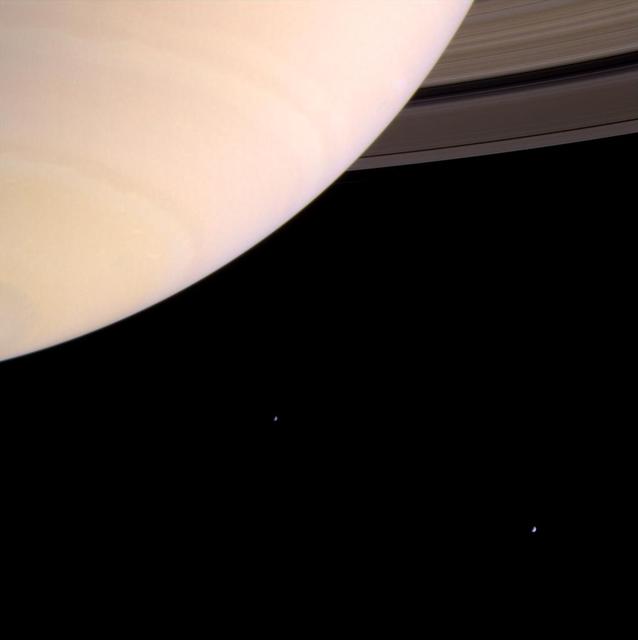
Ver en NASA ↗Saturn shadow stretched beyond the edge of its rings for many years after NASA's Cassini first arrived at Saturn, casting an ever-lengthening shadow that reached its maximum extent at the planet 2009 equinox. This image was captured in 2015.
Ver en NASA ↗The thin sliver of Saturn's moon Prometheus lurks near ghostly structures in Saturn's narrow F ring in this view from NASA's Cassini spacecraft. Many of the narrow ring's faint and wispy features result from its gravitational interactions with Prometheus.
Ver en NASA ↗Artist's concept of a dust storm on Saturn's moon, Titan.
Ver en NASA ↗The 50 year anniversary of the Apollo 11 mission with NASA astronauts Neil Armstrong, Michael Collins, and Buzz Aldrin is celebrated in a 17-minute show, “Apollo 50: Go for the Moon”, by the Smithsonian’s National Air and Space Museum, which combined full-mot…
Ver en NASA ↗The 50 year anniversary of the Apollo 11 mission with NASA astronauts Neil Armstrong, Michael Collins, and Buzz Aldrin is celebrated in a 17-minute show, “Apollo 50: Go for the Moon”, by the Smithsonian’s National Air and Space Museum, which combined full-mot…
Ver en NASA ↗Contenido y metadatos proporcionados por la NASA Image and Video Library.