






/NASA’s%20Artemis%20III%20Announcement%20(Official%20NASA%20Trailer)~thumb.jpg)

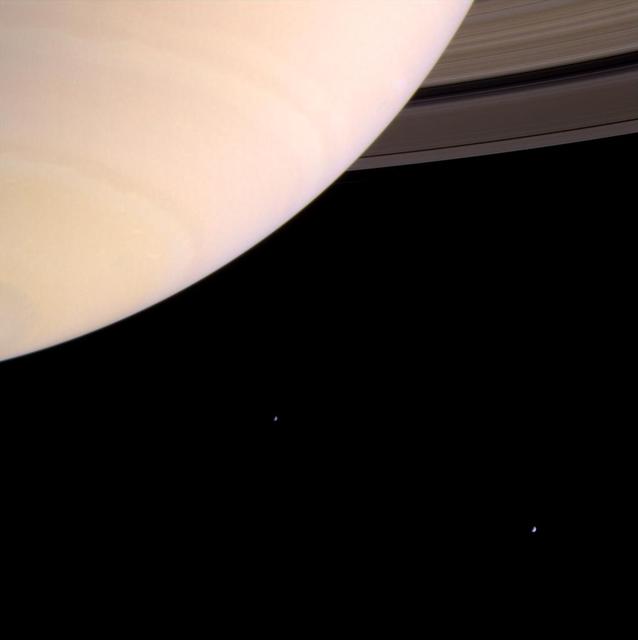
Soft light from Saturn lifts the veil of night from the moons Dione lower left and Rhea upper right
Ver en NASA ↗🚀 Biblioteca espacial oficial
Imágenes y vídeos de NASA
Explora el catálogo multimedia público de NASA sin salir de TuPortalNews.
Explora temas destacados
Selecciona un tema o realiza una búsqueda personalizada.
4.237 resultados en NASA
Saturn potato-shaped moon Prometheus is shown in this close-up from NASA Cassini spacecraft.
Ver en NASA ↗NASA Cassini spacecraft looks toward a crescent of Saturn moon Iapetus and glimpses a bit of that moon yin-yang appearance.
Ver en NASA ↗Multiple jets of icy particles are blasted into space by the active venting on Saturn moon Enceladus
Ver en NASA ↗Beyond the ansa of Saturn rings, a crescent Rhea completes this ring-and-moon composition captured by NASA Cassini spacecraft.
Ver en NASA ↗The Cassini spacecraft peers through the gossamer strands of Saturn innermost rings, whose own shadows adorn the planet beyond
Ver en NASA ↗Saturn moon Mimas joins the planet rings which appear truncated by the planet shadow in this image from NASA Cassini spacecraft.
Ver en NASA ↗As the moon Enceladus eclipses its neighbor Mimas, Cassini records a scene possible only around the time of Saturn approaching equinox.
Ver en NASA ↗The Cassini spacecraft takes a break from the Saturn system to check out the Seven Sisters.
Ver en NASA ↗The shadow of the moon Enceladus appears on Saturn just south of the thin shadow of the planet rings in this image captured by NASA Cassini spacecraft.
Ver en NASA ↗Blazing like an icy torch, the plume of Enceladus shines in scattered sunlight as the moon casts a shadow onto Saturn E ring
Ver en NASA ↗This global digital map of Saturn moon Rhea was created using data obtained by NASA Cassini and Voyager spacecraft.
Ver en NASA ↗The Cassini spacecraft continues to observe brightness variations along the orbital direction within Saturn B ring
Ver en NASA ↗Pan prepares to be engulfed by the darkness of Saturn shadow, visible here as it stretches across the rings
Ver en NASA ↗The shadow of the moon Epimetheus stretches across the B ring in this image taken by Cassini as Saturn approaches its 2009 equinox.
Ver en NASA ↗Atlas joins other moons casting shadows on Saturn rings as the planet approaches its August 2009 equinox.
Ver en NASA ↗Seen from the unlit side of Saturn A ring, the shadow of the moon Janus is cast across the Encke Gap.
Ver en NASA ↗Saturn ring-embedded moons, Pan and Daphnis, are captured in an alignment they repeat with the regularity of a precise cosmic clock
Ver en NASA ↗NASA Cassini spacecraft captures the shadow of Saturn moon Tethys as it seems to disappear as it crosses the planet rings.
Ver en NASA ↗The bright arc within Saturn G ring is shown truncated by the shadow of the planet at the bottom of this image captured by NASA Cassini spacecraft.
Ver en NASA ↗Cassini gazes down toward Saturn unilluminated ringplane to find Janus hugging the outer edge of rings
Ver en NASA ↗As Saturn equinox continues to approach, the moon Pan casts a slightly longer shadow on the A ring.
Ver en NASA ↗Following a successful close flyby of Enceladus, NASA Cassini spacecraft captured this artful composition of the icy moon with Saturn rings beyond.
Ver en NASA ↗As Saturn approaches its August 2009 equinox, a shadow is cast by a narrow, vertically extended feature in the F ring.
Ver en NASA ↗Contenido y metadatos proporcionados por la NASA Image and Video Library.