






/NASA’s%20Artemis%20III%20Announcement%20(Official%20NASA%20Trailer)~thumb.jpg)

This global map of Saturn moon Tethys was created using images taken during flybys of NASA Cassini spacecraft.
Ver en NASA ↗🚀 Biblioteca espacial oficial
Imágenes y vídeos de NASA
Explora el catálogo multimedia público de NASA sin salir de TuPortalNews.
Explora temas destacados
Selecciona un tema o realiza una búsqueda personalizada.
4.237 resultados en NASA
NASA Cassini spacecraft looks toward Saturn largest moon and maps the dark Belet region on Titan.
Ver en NASA ↗Saturn bright ringlets seen here are populated with microscopic icy particles and are among the brightest features in the rings at high phase angles
Ver en NASA ↗Saturn moon Pan casts a longer shadow across the A ring as the planet August 2009 equinox draws near.
Ver en NASA ↗These images from NASA Cassini spacecraft show one of the large seas and a bounty of smaller lakes on Saturn moon Titan.
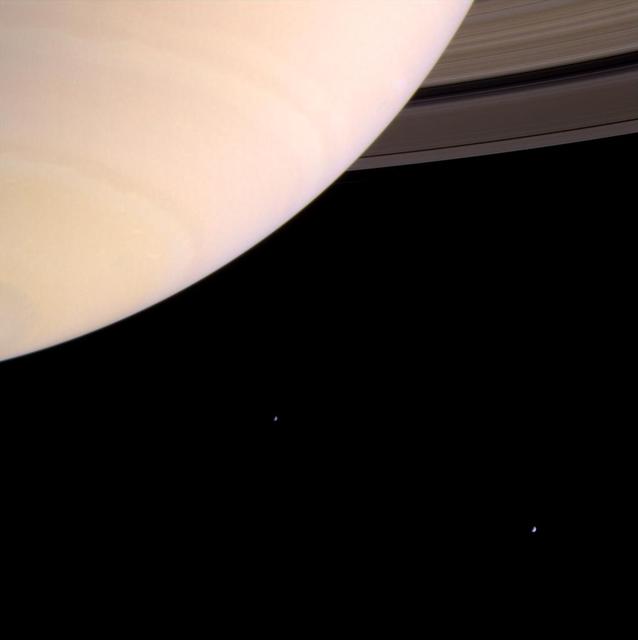
Ver en NASA ↗The shadow of the moon Mimas is cast on Saturn outer A ring in this image which also shows a couple of moons and a collection of stars.
Ver en NASA ↗The shadow of the moon Tethys cuts across the C ring in this image taken as Saturn approaches its August 2009 equinox.
Ver en NASA ↗Light and dark terrain covers the surface of Saturn moon Iapetus in this view from NASA Cassini spacecraft.
Ver en NASA ↗From NASA Cassini spacecraft perspective, Saturn moon Dione passes in front of the moon Tethys in this mutual event.
Ver en NASA ↗The smooth surface of Saturn moon Telesto is documented in this image captured during the NASA Cassini spacecraft Aug. 27, 2009, flyby.
Ver en NASA ↗Three of the small worlds that hug the outer edges of Saturn immense ring system are captured in this Cassini spacecraft portrait
Ver en NASA ↗These side-by-side images obtained by NASA Cassini spacecraft show the feature named Tortola Facula on Saturn moon Titan.
Ver en NASA ↗Like the Voyager spacecraft that came before, NASA Cassini spacecraft chronicles wispy terrain on Saturn moon Dione.
Ver en NASA ↗The Cassini spacecraft looks past the illuminated side of Saturn rings to the brilliant moon Enceladus.
Ver en NASA ↗The Cassini spacecraft provides this dramatic portrait of Janus against the cloud-streaked backdrop of Saturn
Ver en NASA ↗Enceladus continues to exhale water ice into Saturn orbit, keeping the E ring topped off with tiny particles
Ver en NASA ↗This map of Saturn moon Titan identifies the locations of mountains that have been named by the International Astronomical Union.
Ver en NASA ↗This image, taken by NASA Cassini spacecraft, shows the shadows of two moons as they appear on Saturn, above and below the plane of the planet rings.
Ver en NASA ↗Saturn rings are dark and elusive in this view from high above the ringplane, but their shadows on the planet give them away
Ver en NASA ↗The Cassini spacecraft looks down on the north pole of Titan, showing night and day in the northern hemisphere of Saturn largest moon.
Ver en NASA ↗Looking cool and serene, Saturn shares its soft glow with NASA Cassini Orbiter.
Ver en NASA ↗Swinging by Saturn small moon Epimetheus, NASA Cassini spacecraft snapped this shot during the spacecraft April 7, 2010, flyby.
Ver en NASA ↗Immense Saturn is visible through the A ring as Pan coasts along its private corridor
Ver en NASA ↗Saturn rings cast shadows on the planet, except their shadows appear to be inside out in this image captured by NASA Cassini spacecraft.
Ver en NASA ↗Contenido y metadatos proporcionados por la NASA Image and Video Library.