






/NASA’s%20Artemis%20III%20Announcement%20(Official%20NASA%20Trailer)~thumb.jpg)

Attendees of the National Symphony Orchestra performance of Gustav Holst’s “The Planets” listen to a presentation about Mars and Jupiter as they arrive, Wednesday, Jan. 22, 2020, at The Anthem in Washington, DC. Photo Credit: (NASA/Joel Kowsky)
Ver en NASA ↗🚀 Biblioteca espacial oficial
Imágenes y vídeos de NASA
Explora el catálogo multimedia público de NASA sin salir de TuPortalNews.
Explora temas destacados
Selecciona un tema o realiza una búsqueda personalizada.
2.639 resultados en NASA
Miss Baker, a squirrel monkey who made a historical flight aboard the Jupiter (AM-18) in May 1959, is seen here in her viewing area where she resided at the U.S. Space and Rocket Center.
Ver en NASA ↗The Voyager 2 aboard Titan III-Centaur launch vehicle lifted off on August 20, 1977. The Voyager 2 was a scientific satellite to study the Jupiter and the Saturn planetary systems including their satellites and Saturn's rings.
Ver en NASA ↗Artist: unknown (JPL) Saturn Voyager Mission Artwork depicts the spacecraft's path on it's journey to Saturn as it passed above the orbits of Mercury, Venus, Earth, Mars and around Jupiter.
Ver en NASA ↗iss067e119911 (June 7, 2022) --- Jupiter River figures prominently entering the Gulf of St. Lawrence from Anticosti Island in the Canadian provice of Quebec in this photograph from the International Space Station as it orbited 264 miles above.
Ver en NASA ↗NASA's Juno spacecraft captured these images showing surface changes at Nusku Patera (center in each sub-figure) on Jupiter's moon Io.
Ver en NASA ↗The STS-34 crew portrait includes 5 astronauts. Pictured left to right are Shannon W. Lucid, mission specialist; Donald E. Williams, commander; Franklin R. Chang-Diaz, mission specialist; Michael J. McCulley, pilot; and Ellen S. Baker, mission secialist. Th…
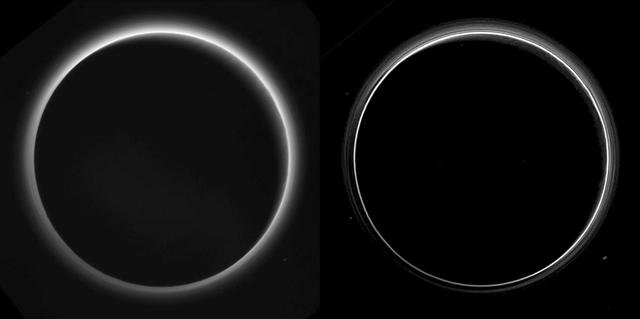
Ver en NASA ↗Range : 900,000 miles A brilliant halo around Jupiter, the thin ring of particles discovered by Voyager 1 four months ago, is seen here unusually bright due to forward scattering of the particles within it. Similiarly, the planet is outlined by sunlight sca…
Ver en NASA ↗Photo Artwork composite by JPL This depiction of comet Shoemaker-Levy 9 impacting Jupiter is shown from several perspectives. IMAGE C is shown from the Voyager 2 spacecraft, which may observe the event from its unique position at the outer reaches of the sola…
Ver en NASA ↗Engineers in a clean room at NASA's Jet Propulsion Laboratory in Southern California build the nadir deck for NASA's Europa Clipper spacecraft.
Ver en NASA ↗Range : 4.0 million km. ( 2.5 million miles ) This brown oval, located between Jupiter's 13 and 18 degree N latitude, may be an opening in the upper cloud deck. It was a selected target to be photographed by Voyager I on its closest approach to Jupiter becau…
Ver en NASA ↗The STS-34 crew of five launched aboard the Space Shuttle Orbiter Atlantis on October 18, 1989 at 12:53:40pm (EDT). Crew members included commander Donald E. Williams, pilot Michael J. McCulley; and mission Specialists Shannon W. Lucid, Franklin R. Chang-Diaz…
Ver en NASA ↗Photo Artwork composite by JPL This depiction of comet Shoemaker-Levy 9 impacting Jupiter is shown from several perspectives. IMAGE B shows the perspective from Galileo spacecraft which can observe the impact point directly. For visual appeal, most of the lar…
Ver en NASA ↗All seven planets discovered in orbit around the red dwarf star TRAPPIST-1 could easily fit inside the orbit of Mercury, the innermost planet of our solar system. In fact, they would have room to spare.
Ver en NASA ↗CAPE CANAVERAL, Fla. -- At the Kennedy Space Center’s SAEF-2 planetary spacecraft checkout facility, technicians work on the spacecraft Galileo prior to moving it to the Vertical Processing Facility for mating with an Inertial Upper Stage. Galileo is schedule…
Ver en NASA ↗Seen here in a clean room at NASA's Jet Propulsion Laboratory in Southern California is the nadir deck for NASA's Europa Clipper spacecraft.
Ver en NASA ↗The STS-34 crew of five launched aboard the Space Shuttle Orbiter Atlantis on October 18, 1989 at 12:53:40pm (EDT). Crew members included commander Donald E. Williams, pilot Michael J. McCulley, and mission Specialists Shannon W. Lucid, Franklin R. Chang-Diaz…
Ver en NASA ↗A new volcanic feature east of Kanehekili on Jupiter's moon Io was imaged by NASA's Juno mission during its 58th close flyby of the gas giant on Feb. 3, 2024.
Ver en NASA ↗This view of Jupiter's moon Europa shows a portion of the surface that has been highly disrupted by fractures and ridges. This image was taken by NASA's Galileo spacecraft on November 6, 1996.
Ver en NASA ↗This global map of Jupiter's moon Io shows the volcanic activity and other surface changes detected by the JunoCam instrument.
Ver en NASA ↗The surface of Jupiter's moon Europa features a widely varied landscape, including ridges, bands, small rounded domes and disrupted spaces that geologists called chaos terrain.
Ver en NASA ↗This newly reprocessed image of Jupiter's moon Europa, taken by NASA's Galileo spacecraft on Sept. 26, 1998, reveals details of diverse surface features.
Ver en NASA ↗ESA (European Space Agency) Director-General Dr. Josef Aschbacher, left, NASA Associate Administrator for the Science Mission Directorate Thomas Zurbuchen, and NASA James Webb Space Telescope Program Manager Jeanne Davis, celebrate after hearing confirmation …
Ver en NASA ↗NASA Associate Administrator for the Science Mission Directorate Thomas Zurbuchen, left, and Centre National d’Etudes Spatiales (CNES) Chairman and CEO Philippe Baptiste, celebrate after hearing confirmation that the James Webb Space Telescope successfully de…
Ver en NASA ↗Contenido y metadatos proporcionados por la NASA Image and Video Library.