





/NASA’s%20Artemis%20III%20Announcement%20(Official%20NASA%20Trailer)~thumb.jpg)

NASA Cassini imaging scientists processed this view of Saturn moon Hyperion, taken during a close flyby on May 31, 2015. This flyby marks the mission final close approach to Saturn largest irregularly shaped moon.
Ver en NASA ↗🚀 Biblioteca espacial oficial
Imágenes y vídeos de NASA
Explora el catálogo multimedia público de NASA sin salir de TuPortalNews.
Explora temas destacados
Selecciona un tema o realiza una búsqueda personalizada.
4.237 resultados en NASA
This set of global, color mosaics of Saturn moon Tethys was produced from images taken by NASA Cassini spacecraft during its first ten years exploring the Saturn system.
Ver en NASA ↗This set of global, color mosaics of Saturn moon Iapetus was produced from images taken by NASA Cassini spacecraft during its first ten years exploring the Saturn system.
Ver en NASA ↗Saturn moon Prometheus casts a narrow shadow on the rings near the much larger shadow cast by the planet in this image taken by NASA Cassini spacecraft about five months after Saturn August 2009 equinox.
Ver en NASA ↗NASA Cassini Orbiter sees Titan become obscured as it moves into eclipse by Saturn. Most of the light comes from refracted sunlight passing through the edge of Saturn atmosphere.
Ver en NASA ↗NASA Cassini spacecraft captures a crescent of Saturn moon Enceladus. Lit terrain seen here is in the area between the leading hemisphere and Saturn-facing side of Enceladus 504 kilometers, or 313 miles across. North on Enceladus is up.
Ver en NASA ↗Terrain on Saturn moon Tethys, defined with craters, is shown in front of the hazy atmosphere of the larger moon Titan in this image from NASA Cassini spacecraft. This view looks toward the Saturn-facing sides of Titan and Tethys.
Ver en NASA ↗Saturn moon Tethys casts a shadow on the planet A ring alongside the larger shadow cast by the planet itself in this image taken as Saturn approached its August 2009 equinox.
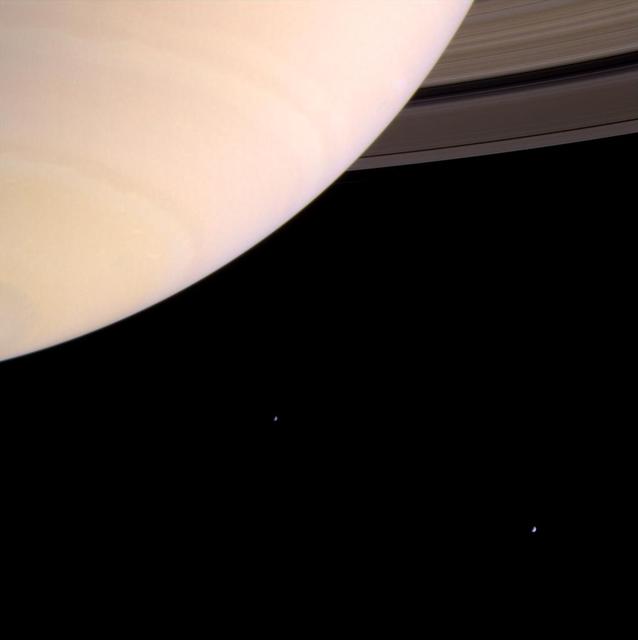
Ver en NASA ↗Two of Saturn moons straddle the planet rings in this color view from NASA Cassini spacecraft. Mimas is closest to NASA Cassini spacecraft here. Epimetheus is on the far side of the rings. Saturn shadow cuts across the middle of the rings.
Ver en NASA ↗A big shadow from Saturn largest moon darkens the planet in the lower right of this image taken by NASA Cassini spacecraft shortly after Saturn August 2009 equinox.
Ver en NASA ↗While on final approach for its Sept. 2007 close encounter with Saturn moon Iapetus, NASA Cassini spacecraft spun around to take in a sweeping view of the Saturn System.
Ver en NASA ↗Rhea and Enceladus hover in the distance beyond Saturn ringplane. Enceladus left, bathed in icy particles from Saturn E ring, appears noticeably brighter than Rhea
Ver en NASA ↗This false-color view taken by NASA Cassini spacecraft is one of a panel of three images of Saturn moon Iapetus showing the boundary of the global color dichotomy on the hemisphere of this moon facing away from Saturn.
Ver en NASA ↗Four of Saturn moons join the planet for a well balanced portrait. Titan, Saturn largest moon, is in the lower left. Tethys appears in upper right. The smaller moons Pandora and Epimetheus are barely visible here.
Ver en NASA ↗Dawn on Saturn is greeted across the vastness of interplanetary space by the morning star, Venus, in this image from NASA Cassini spacecraft. Venus appears just off the edge of the planet directly above the white streak of Saturn G ring.
Ver en NASA ↗The Cassini spacecraft looks toward Rhea cratered, icy landscape with the dark line of Saturn ringplane and the planet murky atmosphere as a background. Rhea is Saturn second-largest moon, at 1,528 kilometers 949 miles across.
Ver en NASA ↗This global map of Saturn moon Dione was created using images taken during flybys by NASA Cassini spacecraft. This global map of Saturn moon Dione was created using images taken during flybys by NASA Cassini spacecraft.
Ver en NASA ↗A pair of Saturn moons, Pan and Janus, cast their shadows on the A ring in this NASA Cassini spacecraft image taken about a month and a half after Saturn August 2009 equinox.
Ver en NASA ↗U.S. Sen. Rick Scott shakes hands with a multi-user spaceport partner inside the Kennedy Space Center Saturn V Conference Center prior to a roundtable discussion among Center Director Bob Cabana and center partners on March 15, 2019. The meeting was held to d…
Ver en NASA ↗An early morning view of the iconic Vehicle Assembly Building, at right, and mobile launcher at NASA's Kennedy Space Center in Florida, on June 21, from the Saturn V center at nearby Kennedy Space Center Visitor Complex. Exploration Ground Systems is preparin…
Ver en NASA ↗With their lights reflected in the water, a nighttime view of the iconic Vehicle Assembly Building, at right, and mobile launcher at NASA's Kennedy Space Center in Florida, on June 21, from the Saturn V center at nearby Kennedy Space Center Visitor Complex. E…
Ver en NASA ↗U.S. Sen. Rick Scott shakes hands with a multi-user spaceport partner inside the Kennedy Space Center Saturn V Conference Center prior to a roundtable discussion among Center Director Bob Cabana and center partners on March 15, 2019. The meeting was held to d…
Ver en NASA ↗A/S 201 was launched from the Kennedy Space Center Launch Complex 34 at 11:12 a.m., 02/26/1966. The instrumented Apollo Command and Service Module, and, a spacecraft Lunar Excursion Module Adapter, was successfully launched on the unmanned suborbital mission …
Ver en NASA ↗S68-56001 (21 Dec. 1968) --- The Apollo 8 (Spacecraft 103/Saturn 503) space vehicle is launched from Pad A, Launch Complex 39, Kennedy Space Center, at 7:51 a.m. (EST), Dec. 21, 1968. The crew of the Apollo 8 lunar orbit mission is astronauts Frank Borman, co…
Ver en NASA ↗Contenido y metadatos proporcionados por la NASA Image and Video Library.