







/NASA’s%20Artemis%20III%20Announcement%20(Official%20NASA%20Trailer)~thumb.jpg)

At Cape Canaveral Air Force Station's Space Launch Complex 37, the Delta IV Heavy rocket with NASA's Parker Solar Probe, lifts off at 3:31 a.m. EDT on Sunday, Aug. 12, 2018. The spacecraft was built by Applied Physics Laboratory of Johns Hopkins University in…
Ver en NASA ↗🚀 Biblioteca espacial oficial
Imágenes y vídeos de NASA
Explora el catálogo multimedia público de NASA sin salir de TuPortalNews.
Explora temas destacados
Selecciona un tema o realiza una búsqueda personalizada.
6.564 resultados en NASA
The United Launch Alliance Delta IV Heavy first stage has been lifted to the vertical position and is inside the Vertical Integration Facility near Space Launch 37 at Cape Canaveral Air Force Station in Florida. The Delta IV Heavy will launch NASA's upcoming …
Ver en NASA ↗At Cape Canaveral Air Force Station’s Space Launch Complex 37, the United Launch Alliance Delta IV Heavy rocket with NASA's Parker Solar Probe, lifts off at 3:31 a.m. EDT on Sunday, Aug. 12, 2018. The spacecraft was built by Applied Physics Laboratory of John…
Ver en NASA ↗A partial eclipse on Florida's Space Coast, the rare astronomical event was photographed from the top of the Vehicle Assembly Building, as the Moon passed between Earth and the midafternoon Sun. The Moon's shadow moved across the landscape from Oregon to Sout…
Ver en NASA ↗Technicians offloaded NASA’s Carruthers Geocorona Observatory following the spacecraft’s arrival on Monday, July 201, 2025, at the Astrotech Space Operations Facility near the agency’s Kennedy Space Center in Florida. The Carruthers Geocorona Observatory is a…
Ver en NASA ↗The United Launch Alliance Delta IV Heavy rocket launches NASA's Parker Solar Probe to touch the Sun, Sunday, Aug. 12, 2018 from Launch Complex 37 at Cape Canaveral Air Force Station, Florida. Parker Solar Probe is humanity’s first-ever mission into a part of…
Ver en NASA ↗The United Launch Alliance Delta IV Heavy rocket launches NASA's Parker Solar Probe to touch the Sun, Sunday, Aug. 12, 2018 from Launch Complex 37 at Cape Canaveral Air Force Station, Florida. Parker Solar Probe is humanity’s first-ever mission into a part of…
Ver en NASA ↗A partial eclipse on Florida's Space Coast, the rare astronomical event was photographed from the top of the Vehicle Assembly Building, as the Moon passed between Earth and the midafternoon Sun. The Moon's shadow moved across the landscape from Oregon to Sout…
Ver en NASA ↗51F-31-006 (29 July -- 6 Aug. 1985) --- An oblique view of the sun rising over Earth during late July of 1985, as photographed from the Earth orbiting Challenger. The sun reflects off Indian Ocean waters near the intersection with the Tasman Sea. A handhel…
Ver en NASA ↗The United Launch Alliance Delta IV Heavy rocket launches NASA's Parker Solar Probe to touch the Sun, Sunday, Aug. 12, 2018 from Launch Complex 37 at Cape Canaveral Air Force Station, Florida. Parker Solar Probe is humanity’s first-ever mission into a part of…
Ver en NASA ↗At Cape Canaveral Air Force Station's Space Launch Complex 37, the United Launch Alliance Delta IV Heavy rocket with NASA's Parker Solar Probe, lifts off at 3:31 a.m. EDT on Sunday, Aug. 12, 2018. The spacecraft was built by Applied Physics Laboratory of John…
Ver en NASA ↗cmasaw3_20260407012240_007.JPG
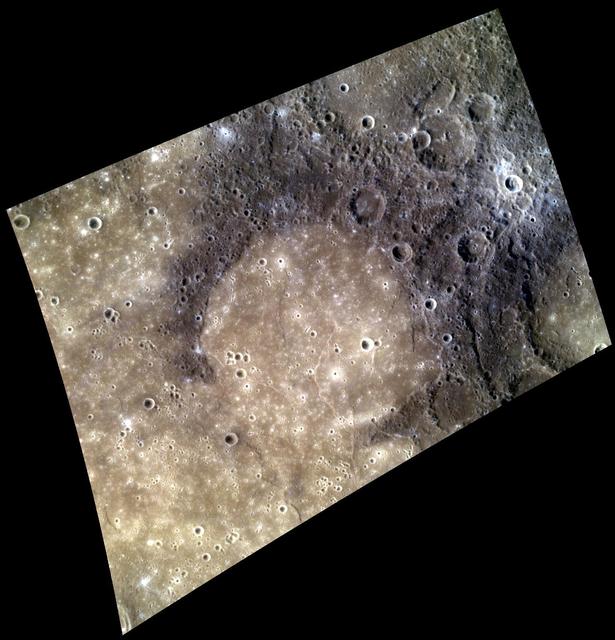
Ver en NASA ↗This mosaic from NASA's MESSENGER of Caloris basin is an enhanced-color composite overlain on a monochrome mosaic. It is made up of images obtained when both the spacecraft and the Sun were overhead, conditions best for discerning variations in albedo.
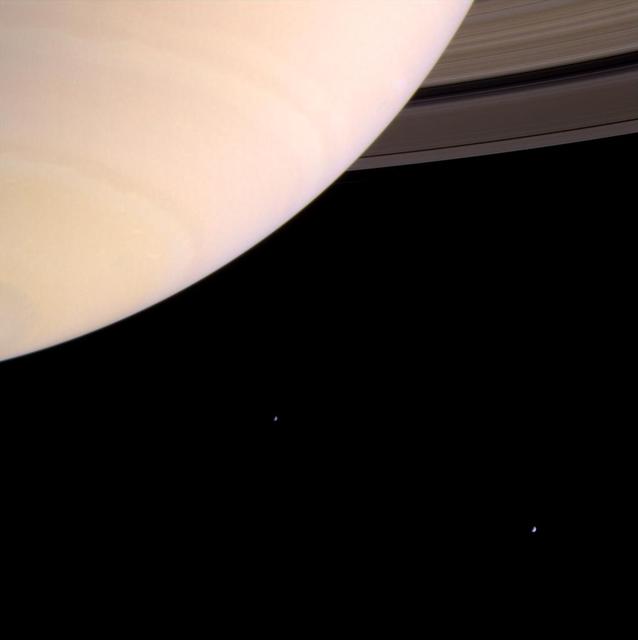
Ver en NASA ↗NASA Cassini orbiter shows Saturn main rings, seen here on their lit face, appear much darker than normal. That because they tend to scatter light back toward its source -- in this case, the Sun.
Ver en NASA ↗NASA's Perseverance Mars rover used its Mastcam-Z camera to capture Mercury – seen as a tiny speck – passing in front of the Sun on Oct. 28, 2023.
Ver en NASA ↗The potential planet-forming disk or protoplanetary disk of a sun-like star is being violently ripped away by the powerful winds of a nearby hot O-type star in this image from NASA's Spitzer Space Telescope.
Ver en NASA ↗NASA's Ingenuity helicopter captured this view on Nov. 3, 2023, of its parking spot during Mars solar conjunction – a period when the Sun is between Earth and Mars, limiting communications.
Ver en NASA ↗VANDENBERG AIR FORCE BASE, Calif. – Technicians and engineers at Vandenberg Air Force Base in California mate the Pegasus XL rocket with the Interface Region Imaging Spectrograph, or IRIS, solar observatory to the Orbital Sciences L-1011 carrier aircraft. …
Ver en NASA ↗VANDENBERG ABF, Calif. - The Orbital Sciences launch team monitors the Pegasus XL rocket that will lift NASA's IRIS solar observatory into orbit as the rocket and payload are moved from a hangar onto a transporter at Vandenberg Air Force Base. IRIS, short for…
Ver en NASA ↗VANDENBERG AFB – Engineers move the payload fairing into place for NASA's IRIS spacecraft. The fairing connects to the nose of the Orbital Sciences Pegasus XL rocket that will lift the solar observatory into orbit in June. The work is taking place in a hangar…
Ver en NASA ↗VANDENBERG AFB, Calif. – Engineers unwrap NASA's IRIS spacecraft after its connection to the nose of an Orbital Sciences Pegasus XL rocket that will lift the solar observatory into orbit in June. The work is taking place in a hangar at Vandenberg Air Force Ba…
Ver en NASA ↗VANDENBERG AIR FORCE BASE, Calif. – At Vandenberg Air Force Base in California, technicians and engineers prepare a separation system ring that will be attached to NASA's Interface Region Imaging Spectrograph, or IRIS, spacecraft. The separation system will p…
Ver en NASA ↗VANDENBERG AFB – NASA's IRIS spacecraft before the second half of the payload fairing is installed over it. The fairing connects to the nose of the Orbital Sciences Pegasus XL rocket that will lift the solar observatory into orbit in June. The work is taking …
Ver en NASA ↗VANDENBERG AFB, Calif. – Engineers prepare to connect NASA's IRIS spacecraft to the nose of an Orbital Sciences Pegasus XL rocket that will lift the solar observatory into orbit in June. The work is taking place in a hangar at Vandenberg Air Force Base where …
Ver en NASA ↗Contenido y metadatos proporcionados por la NASA Image and Video Library.