







/NASA’s%20Artemis%20III%20Announcement%20(Official%20NASA%20Trailer)~thumb.jpg)


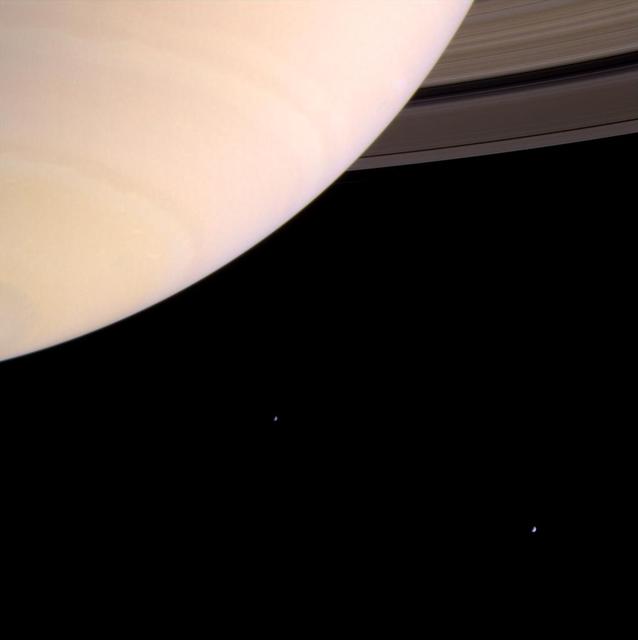
Among the interplay of Saturn shadow and rings, Mimas, which appears in the lower-right corner of the image, orbits Saturn as a set of the ever-intriguing spokes appear in the B ring to the right of center in this image from NASA Cassini spacecraft.
Ver en NASA ↗🚀 Biblioteca espacial oficial
Imágenes y vídeos de NASA
Explora el catálogo multimedia público de NASA sin salir de TuPortalNews.
Explora temas destacados
Selecciona un tema o realiza una búsqueda personalizada.
4.237 resultados en NASA
This image, taken by NASA Cassini spacecraft, shows A beautiful mini-jet appearing in the dynamic F ring of Saturn. Saturn A ring including the Keeler gap and just a hint of the Encke gap at the upper-right also appears.
Ver en NASA ↗The sharp outer boundary of Saturn B ring, which is the bright ring region seen to the right in this image, is maintained by a strong resonance with the moon Mimas. For every two orbits made by particles at this distance from Saturn
Ver en NASA ↗NASA Cassini spacecraft looks toward the limb of Saturn and, on the right of this image, views part of the rings through the planet atmosphere. Saturn atmosphere can distort the view of the rings from some angles.
Ver en NASA ↗Saturn casts its shadow on the rings in this NASA Cassini spacecraft image that also shows how the rings reflect sunlight onto the dark side of the planet. Here Saturn appears dimly illuminated by this ringshine.
Ver en NASA ↗Ghostly spokes in Saturn B ring continue to put on a show for NASA Cassini spacecraft cameras in this recent image. The spokes, believed to be a seasonal phenomenon, are expected to disappear as Saturn nears its northern hemisphere summer.
Ver en NASA ↗Saturn moon Epimetheus moves in front of the larger moon Janus as seen by NASA Cassini spacecraft. The moons are lit by sunlight on the left and light reflected off Saturn on the right.
Ver en NASA ↗Waves in the edges of the Keeler gap in Saturn A ring, created by the embedded moon Daphnis, show considerable complexity in this image taken as Saturn approached its August 2009 equinox.
Ver en NASA ↗This set of global, color mosaics of Saturn moon Dione taken by NASA Cassini spacecraft during its first ten years exploring the Saturn system; obvious feature on the maps is the difference in color and brightness between the two hemispheres.
Ver en NASA ↗NASA Cassini spacecraft images dark spokes on Saturn B ring. Spokes are radial markings on Saturn rings that continue to interest scientists, and they can be seen here stretching left to right across the image.
Ver en NASA ↗NASA Cassini spacecraft catches Saturn moon Daphnis making waves and casting shadows from the narrow Keeler Gap of the planet A ring in this view taken around the time of Saturn August 2009 equinox.
Ver en NASA ↗Speeding toward pale, icy Dione, Cassini view is enriched by the tranquil gold and blue hues of Saturn in the distance. The horizontal stripes near the bottom of the image are Saturn rings.
Ver en NASA ↗The shadow of Saturn rings looks like a belt fastened around the planet equator in this image. Overexposure to bring out the ring details makes Saturn appear especially bright.
Ver en NASA ↗This set of global, color mosaics of Saturn moon Enceladus was produced from images taken by NASA Cassini spacecraft during its first ten years exploring the Saturn system.
Ver en NASA ↗NASA Cassini spacecraft captured this close view of Saturn moon Pandora during the spacecraft flyby on June 3, 2010. Pandora orbits beyond Saturn thin F ring.
Ver en NASA ↗Darkness sweeps over Iapetus as the Cassini spacecraft watches the shadow of Saturn B ring engulf the dichotomous moon. The image at left shows the unshaded moon, while at right, Iapetus sits in the shadow of the densest of Saturn rings
Ver en NASA ↗Saturn moon Dione hangs in front of Saturn rings in this view taken by NASA Cassini spacecraft during the inbound leg of its last close flyby of the icy moon.
Ver en NASA ↗Saturn moon Janus orbits in front of the rings, which are partially darkened by the shadow of the planet in viwe from NASA Cassini spacecraft. Saturn shadow obscures about half the rings.
Ver en NASA ↗Saturn moon Dione dwarfs the moon Telesto in this image captured by NASA Cassini spacecraft image. Dione is the fourth largest of Saturn moons, and it dominates this view. Tiny Telesto can be seen below and to the left of Dione.
Ver en NASA ↗This plot shows the variation in brightness of the plume of material, composed of all the geysers erupting from the south polar terrain of Saturn moon Enceladus, as a function of the moon orbital position around Saturn.
Ver en NASA ↗Saturn moon Tethys, with its stark white icy surface, peeps out from behind the larger, hazy, colorful Titan in this view of the two moons obtained by NASA Cassini spacecraft. Saturn rings lie between the two.
Ver en NASA ↗The tortured terrain of Saturn moon Dione is documented in this NASA Cassini spacecraft image. The wispy fractures on the moon trailing hemisphere can be seen on the left, and cratered terrain on the moon anti-Saturn side dominates the center.
Ver en NASA ↗Saturn moon Pan, named for the Greek god of shepherds, rules over quite a different domain: the Encke gap in Saturn rings. This image is from NASA Cassini spacecraft.
Ver en NASA ↗NASA Cassini orbiter has revealed many surprises within the Saturn system, including the possible presence of a ring of debris surrounding the ancient heavily cratered surface of Rhea, Saturn second largest moon.
Ver en NASA ↗Contenido y metadatos proporcionados por la NASA Image and Video Library.