






/NASA’s%20Artemis%20III%20Announcement%20(Official%20NASA%20Trailer)~thumb.jpg)

The Apollo 11 mission, the first manned lunar mission, launched from the Kennedy Space Center, Florida via the Saturn V launch vehicle on July 16, 1969 and safely returned to Earth on July 24, 1969. The Saturn V vehicle was developed by the Marshall Space Fli…
Ver en NASA ↗🚀 Biblioteca espacial oficial
Imágenes y vídeos de NASA
Explora el catálogo multimedia público de NASA sin salir de TuPortalNews.
Explora temas destacados
Selecciona un tema o realiza una búsqueda personalizada.
4.237 resultados en NASA
Donned in biological isolation garments, the Apollo 11 crew members, (L-R) Edwin Aldrin, Neil Armstrong (waving), and Michael Collins exit the recovery pick up helicopter to board the U.S.S. Hornet aircraft carrier after splashdown. The recovery operation too…
Ver en NASA ↗The Apollo 11 mission, the first manned lunar mission, launched from the Kennedy Space Center, Florida via the Saturn V launch vehicle on July 16, 1969 and safely returned to Earth on July 24, 1969. The Saturn V vehicle was developed by the Marshall Space Fli…
Ver en NASA ↗Dr. Thomas Paine, NASA administrator (left) and U.S. President Richard Milhous Nixon wait aboard the recovery ship, the U.S.S. Hornet, for splashdown of the Apollo 11 in the Pacific Ocean. Navy para-rescue men recovered the capsule housing the 3-man crew. The…
Ver en NASA ↗The propeller informally named Earhart is seen in this view from NASA's Cassini spacecraft at much higher resolution than ever before. In this view, half of the Encke Gap is visible as the dark region at right.
Ver en NASA ↗This zoomed-in view of Epimetheus, one of the highest resolution ever taken by NASA's Cassini spacecraft, shows a surface covered in craters, vivid reminders of the hazards of space.
Ver en NASA ↗This image shows a region in Saturn outer B ring. NASA's Cassini spacecraft viewed this area at a level of detail twice as high as it had ever been observed before. And from this view, it is clear that there are still finer details to uncover.
Ver en NASA ↗Streaks of cloud are overlain with graceful ring shadows in this view of Saturn northern latitudes
Ver en NASA ↗The moon Pandora casts a shadow onto Saturn A ring but not the F ring.
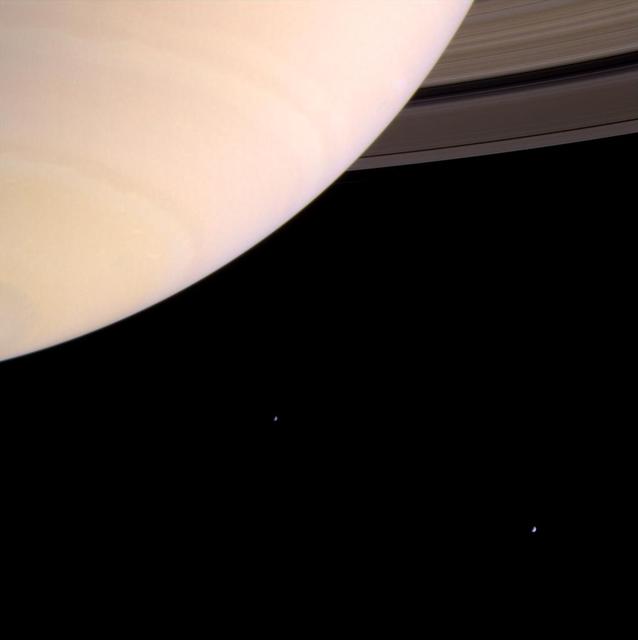
Ver en NASA ↗Two moons of Saturn rendezvous in the Saturnian skies above the Cassini spacecraft
Ver en NASA ↗NASA Cassini spacecraft spies the large Penelope crater on Saturn moon Tethys.
Ver en NASA ↗A large impact basin dominates the high southern latitudes of Saturn moon Dione.
Ver en NASA ↗The Cassini Division appears to emerge out of Saturn shadow in this Cassini spacecraft image
Ver en NASA ↗Beside the swirling face of Saturn floats a small, icy attendant
Ver en NASA ↗Bright icy fractures, or linea, cover the trailing hemisphere of Saturn moon, Dione
Ver en NASA ↗A small icy world plies the space between Saturn A and F rings
Ver en NASA ↗A couple of craters share a crescent of lit terrain on Saturn moon Rhea.
Ver en NASA ↗The effects of the moon Prometheus create intricate formations in Saturn thin F ring.
Ver en NASA ↗Saturn moon Tethys with its prominent Odysseus Crater silently slips behind Saturn largest moon Titan and then emerges on the other side in this image taken by NASA Cassini spacecraft.
Ver en NASA ↗This set of global, color mosaics of Saturn moon Mimas was produced from images taken by NASA Cassini spacecraft during its first ten years exploring the Saturn system.
Ver en NASA ↗The effects of the small moon Prometheus loom large on two of Saturn rings in this image taken by NASA Cassini spacecraft a short time before Saturn August 2009 equinox.
Ver en NASA ↗This set of global, color mosaics of Saturn moon Rhea was produced from images taken by NASA Cassini spacecraft during its first ten years exploring the Saturn system.
Ver en NASA ↗The shadow of Saturn cuts across the rings as seen by NASA Cassini spacecraft. As the ring particles enter Saturn shadow, their temperature drops to even colder temperatures, only to warm back up again when they re-emerge into the sunlight.
Ver en NASA ↗NASA Cassini imaging scientists processed this view of Saturn moon Hyperion, taken during a close flyby on May 31, 2015. This flyby marks the mission final close approach to Saturn largest irregularly shaped moon.
Ver en NASA ↗Contenido y metadatos proporcionados por la NASA Image and Video Library.