





/NASA’s%20Artemis%20III%20Announcement%20(Official%20NASA%20Trailer)~thumb.jpg)

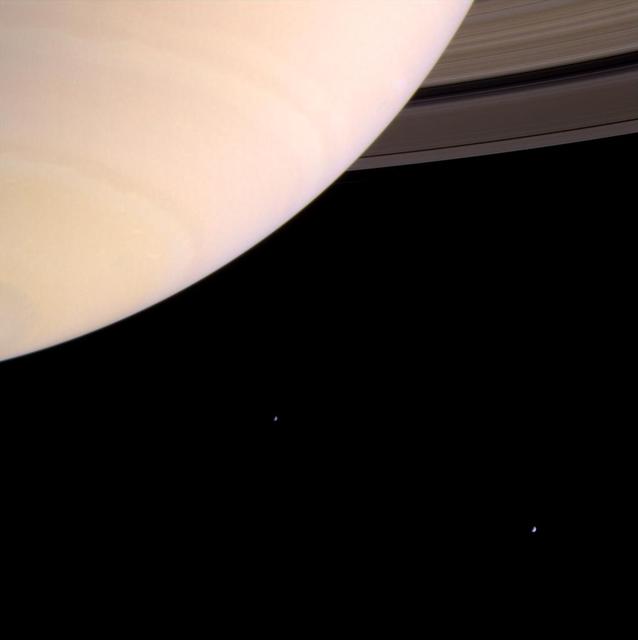
Saturn looms in the foreground of this mosaic of Cassini images, taken by the spacecraft on May 28, 2017. The planet is adorned by ring shadows. The icy rings emerge from behind the planet. The Cassini spacecraft ended its mission on Sept. 15, 2017.
Ver en NASA ↗🚀 Biblioteca espacial oficial
Imágenes y vídeos de NASA
Explora el catálogo multimedia público de NASA sin salir de TuPortalNews.
Explora temas destacados
Selecciona un tema o realiza una búsqueda personalizada.
4.237 resultados en NASA
This photograph shows the launch of the SA-513, a modified unmarned two-stage Saturn V vehicle for the Skylab-1 mission, which placed the Skylab cluster into the Earth orbit on May 14, 1973. The initial step in the Skylab mission was the launch of a two-stage…
Ver en NASA ↗Dr. von Braun pauses in front of the Saturn V vehicle being readied for the historic Apollo 11 lunar landing mission at the Kennedy Space Center (KSC). The Saturn V vehicle was developed by the Marshall Space Flight Center (MSFC) under the direction of Dr. vo…
Ver en NASA ↗Dr. von Braun pauses in front of the Saturn V vehicle being readied for the historic Apollo 11 lunar landing mission at the Kennedy Space Center (KSC). The Saturn V vehicle was developed by the Marshall Space Flight Center (MSFC) under the direction of Dr. vo…
Ver en NASA ↗Dr. von Braun pauses in front of the Saturn V vehicle being readied for the historic Apollo 11 lunar landing mission at the Kennedy Space Center (KSC). The Saturn V vehicle was developed by the Marshall Space Flight Center (MSFC) under the direction of Dr. vo…
Ver en NASA ↗This colorful spectrogram represents data collected by the Radio and Plasma Wave Science instrument onboard NASA's Cassini's spacecraft as it crossed through Saturn's D ring on May 28, 2017.
Ver en NASA ↗CAPE CANAVERAL, Fla. – NASA astronaut candidates Anne McClain, from left, Andrew Morgan, Nicole Mann, Victor Glover, Christina Hammock and Josh Cassada observe the Apollo 14 command module which carried astronauts Alan Shepard, Stu Roosa and Edgar Mitchell on…
Ver en NASA ↗The northern and southern hemispheres of Saturn's moon Mimas are seen in these polar stereographic maps, mosaicked from the best-available images taken by NASA's Cassini spacecraft.
Ver en NASA ↗S62-05105 (14 September 1962) --- Artist's concept of a Saturn launch.
Ver en NASA ↗Both the limb of Saturn and the shadow of its ring system are seen through the transparent C-ring in this striking picture taken by NASA Voyager 1 on Nov. 9, 1980. Gaps and regions of high transparency are seen throughout the C-ring, especially in the a
Ver en NASA ↗This rare color view of Saturn night side shows how the rings dimly illuminate the southern hemisphere, giving it a dull golden glow. Part of the northern dark side is just visible at top -- the illumination it receives being far less than the south
Ver en NASA ↗A bird's-eye view of Apollo 6 and its gantry leaving the Vehicle Assembly Building on the transporter heading to the launch site on Pad 39-A at Kennedy Space Center. The towering 363-foot Saturn V was a multi-stage, multi-engine launch vehicle standing taller…
Ver en NASA ↗A close-up view of the Apollo 11 command service module ready to be mated with the spacecraft LEM adapter of the third stage. The towering 363-foot Saturn V was a multi-stage, multi-engine launch vehicle standing taller than the Statue of Liberty. Altogether,…
Ver en NASA ↗This is a cutaway illustration of the Saturn V command module (CM) configuration. The CM was crammed with some of the most complex equipment ever sent into space at the time. The three astronaut couches were surrounded by instrument panels, navigation gear, r…
Ver en NASA ↗AS-501, the first flight of the Saturn V launch vehicle, takes flight from Kennedy Space Center's Launch Pad 39A on November 9, 1967. The unmanned mission, also designated Apollo 4, marked the first test flight of the S-IC and S-II stages, developed for the S…
Ver en NASA ↗Workmen at the Kennedy Space Center hoist the Saturn Lunar Module (LM) Adapter into position during assembly of the 204LM-1, an unmanned Apollo mission that tested the Apollo Lunar Module in Earth orbit. Also known as Apollo 5, the spacecraft was launched on …
Ver en NASA ↗Recent images captured by NASA's Cassini spacecraft show features in Saturn's C ring called 'plateaus' revealing a streaky texture that is very different from the textures of the regions around them.
Ver en NASA ↗The brightly lit limb of a crescent Enceladus looks ethereal against the blackness of space as seen by NASA's Cassini's spacecraft. The rest of the moon, lit by light reflected from Saturn, presents a ghostly appearance.
Ver en NASA ↗This close-up view captured by NASA's Cassini spacecraft of the Keeler Gap, which is near the outer edge of Saturn's main rings, shows in great detail just how much the moon Daphnis affects the edges of the gap.
Ver en NASA ↗Workmen at the Kennedy Space Center position the nose cone for the 204LM-1, an unmanned Apollo mission that tested the Apollo Lunar Module (LM) in Earth orbit. Also known as Apollo 5, the spacecraft was launched on the fourth Saturn IBC launch vehicle. Develo…
Ver en NASA ↗Teams lift the first stage of the Apollo 8 Saturn V rocket inside the transfer aisle of the Vehicle Assembly Building at NASA’s Kennedy Space Center in Florida on Feb. 1, 1968, and prepare to place it atop the mobile launcher. Apollo 8 was the first crewed sp…
Ver en NASA ↗This view from NASA's Cassini spacecraft shows a wave structure in Saturn's rings known as the Janus 2:1 spiral density wave.
Ver en NASA ↗This chart provides the vital statistics for the F-1 rocket engine. Developed by Rocketdyne, under the direction of the Marshall Space Flight Center, the F-1 engine was utilized in a cluster of five engines to propel the Saturn V's first stage, the S-IC. Liqu…
Ver en NASA ↗This image depicts a firing of a single H-1 engine at the Marshall Space Flight Center’s (MSFC’s) Power Plant test stand. This 1950s test stand, inherited from the Army, was used to test fire engines until the Test Area was completed in the latter 1960s. The …
Ver en NASA ↗Contenido y metadatos proporcionados por la NASA Image and Video Library.