





/NASA’s%20Artemis%20III%20Announcement%20(Official%20NASA%20Trailer)~thumb.jpg)

The test laboratory of the Marshall Space Flight Center (MSFC) tested the F-1 engine, the most powerful rocket engine ever fired at MSFC. The engine was tested on the newly modified Saturn IB static test stand that had been used for three years to test the Sa…
Ver en NASA ↗🚀 Biblioteca espacial oficial
Imágenes y vídeos de NASA
Explora el catálogo multimedia público de NASA sin salir de TuPortalNews.
Explora temas destacados
Selecciona un tema o realiza una búsqueda personalizada.
4.237 resultados en NASA
The test laboratory of the Marshall Space Flight Center (MSFC) tested the F-1 engine, the most powerful rocket engine ever fired at MSFC. The engine was tested on the newly modified Saturn IB Static Test Stand which had been used for three years to test the S…
Ver en NASA ↗Two workers are dwarfed by the five J-2 engines of the Saturn V second stage (S-II) as they make final inspections prior to a static test firing by North American Space Division. These five hydrogen -fueled engines produced one million pounds of thrust, and p…
Ver en NASA ↗This view from NASA's Cassini spacecraft shows planet Earth as a point of light between the icy rings of Saturn. Cassini was 870 million miles (1.4 billion kilometers) away from Earth when the image was taken.
Ver en NASA ↗NASA Cassini spacecraft in a Jet Propulsion Laboratory assembly room in 1997.
Ver en NASA ↗In this image from NASA's Cassini spacecraft, a bright and narrow ringlet located toward the outer edge of the C ring is flanked by two broader features called plateaus.
Ver en NASA ↗This is the first image of Saturn's ultraviolet aurora taken by the Space Telescope Imaging Spectrograph (STIS) on board the Hubble Space Telescope (HST) in October 1998, when Saturn was a distance of 810 million miles (1.3 billion kilometers) from Earth. The…
Ver en NASA ↗NASA's Cassini spacecraft bids farewell to Saturn's yin-and-yang moon, Iapetus. This image is from the last set of observations Cassini made of this world of striking contrasts.
Ver en NASA ↗Saturn's atmosphere and its rings are shown here in a false color composite made from images taken by NASA's Cassini spacecraft in near infrared light through filters that sense different amounts of methane gas.
Ver en NASA ↗June Scobee Rodgers receives the Education Award during the Apollo 50th Gala, presented by Northrop Grumman, inside the Apollo/Saturn V Center at the Kennedy Space Center Visitor Complex in Florida on July 16, 2019. Scobbee Rodgers is the founding chairman of…
Ver en NASA ↗The National Space Council meets inside the Apollo/Saturn V Center at the Kennedy Space Center Visitor Complex in Florida on Dec. 9, 2020. The council's role is to advise the president regarding national space policy and strategy and to review the nation's lo…
Ver en NASA ↗Michael Collins; right; Apollo 11 astronaut; presents the Innovation Award to David Thompson; left; founder; president and CEO of Orbital Sciences Corp (later known as Orbital ATK); during the Apollo 50th Gala on July 16; 2019. The event; presented by Northro…
Ver en NASA ↗The National Space Council meets inside the Apollo/Saturn V Center at the Kennedy Space Center Visitor Complex in Florida on Dec. 9, 2020. The council's role is to advise the president regarding national space policy and strategy, and to review the nation's l…
Ver en NASA ↗This approximate natural-color image from NASA's Voyager 2 shows Saturn, its rings, and four of its icy satellites. Three satellites Tethys, Dione, and Rhea are visible against the darkness of space.
Ver en NASA ↗On July 19, 2013, in an event celebrated the world over, NASA's Cassini spacecraft slipped into Saturn shadow and turned to image the planet, seven of its moons, its inner rings, and, in the background, our home planet, Earth.
Ver en NASA ↗Peering over the shoulder of giant Saturn, through its rings, and across interplanetary space, NASA Cassini spacecraft spies the bright, cloudy terrestrial planet, Venus.
Ver en NASA ↗The first stage of the Apollo 11 Saturn V (S-1C-6) rocket awaits its departure from the Michoud Assembly Facility in New Orleans, LA. Image dated 11-6-1967.
Ver en NASA ↗This colorful view from NASA Cassini mission, known as the
Ver en NASA ↗This artist concept illustrates how charged water particles flow into the Saturnian atmosphere from the planet rings, causing a reduction in atmospheric brightness.
Ver en NASA ↗This image from NASA's Cassini spacecraft shows that the rings of Saturn are made mostly of particles of water ice that range in size from smaller than a grain of sand to as large as mountains.
Ver en NASA ↗Saturn's moon Enceladus drifts before the rings and the tiny moon Pandora in this view captured by NASA's Cassini spacecraft on Nov. 1, 2009. The Sun provides striking illumination for the icy particles that make up both the rings and the jets.
Ver en NASA ↗Cassini obtained this panoramic view of Saturn's rings on Sept. 9, 2017, just minutes after it passed through the ring plane. The Cassini spacecraft ended its mission on Sept. 15, 2017.
Ver en NASA ↗Scientists with NASA Cassini mission have spotted two features shaped like the 1980s video game icon Pac-Man on moons of Saturn. One was observed on the moon Mimas in 2010 and the latest was observed on the moon Tethys.
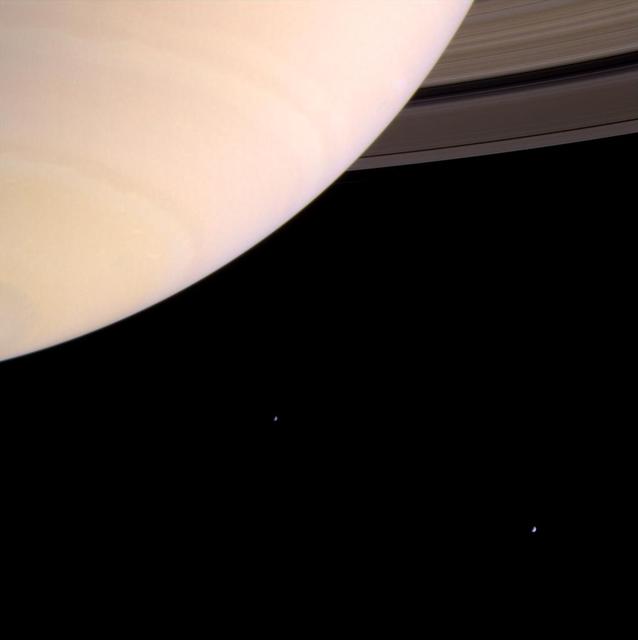
Ver en NASA ↗This colorful view, taken from edge-on with the ringplane by NASA's Cassini oribter on July 24, 2007, contains four of Saturn's attendant moons. Tethys.
Ver en NASA ↗Contenido y metadatos proporcionados por la NASA Image and Video Library.