





/NASA’s%20Artemis%20III%20Announcement%20(Official%20NASA%20Trailer)~thumb.jpg)

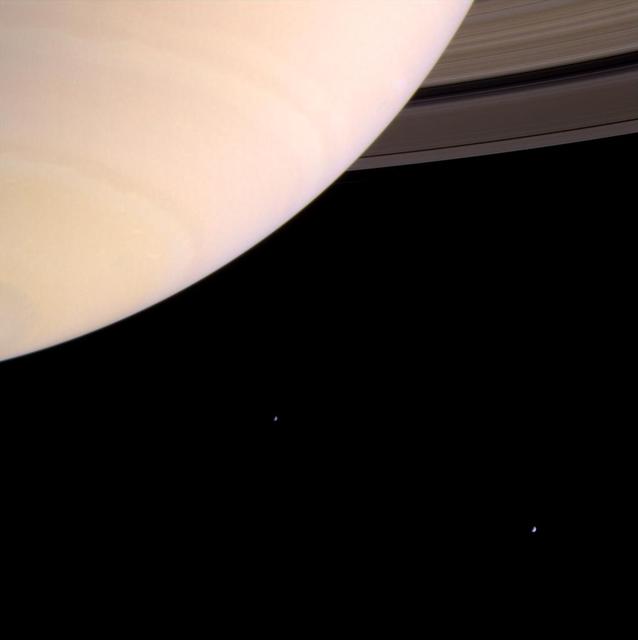
The moons Mimas and Janus seem insignificant in front of the immensity of Saturn in this NASA Cassini spacecraft image. Mimas is visible above the rings near the center; Janus is barely detectable as a tiny speck of light below the rings on the left.
Ver en NASA ↗🚀 Biblioteca espacial oficial
Imágenes y vídeos de NASA
Explora el catálogo multimedia público de NASA sin salir de TuPortalNews.
Explora temas destacados
Selecciona un tema o realiza una búsqueda personalizada.
4.237 resultados en NASA
The highly reflective moon Enceladus appears as a bright dot beyond a crescent Saturn in this image from NASA Cassini spacecraft. Enceladus is visible above the ringplane to the left of the center of the image.
Ver en NASA ↗Stately Saturn sits surrounded by its darkened disk of ice. An increasing range of hues has become visible in the northern hemisphere as spring approaches and the ring shadows slide southward
Ver en NASA ↗Enceladus unusual plume is only easily visible when NASA Cassini spacecraft and the Sun are on opposite sides of Enceladus. So what lighting up the moon then? It light reflected off Saturn.
Ver en NASA ↗The Cassini spacecraft shows a section of Saturn and its rings which includes a special treat made possible as the planet approaches its August 2009 equinox: the shadow of a moon cast on the rings.
Ver en NASA ↗Reflected sunlight is the source of the illumination for visible wavelength images such as this image from NASA's Cassini spacecraft.
Ver en NASA ↗Apollo 6, the second and last of the unmarned Saturn V test flights, is slowly transported past the Vehicle Assembly Building on the way to launch pad 39-A. The towering 363-foot Saturn V was a multi-stage, multi-engine launch vehicle standing taller than the…
Ver en NASA ↗Searchlights penetrate the darkness surrounding Apollo 8 on Pad 39-A at Kennedy Space Center. This mission was the first manned flight using the Saturn V. The towering 363-foot Saturn V was a multi-stage, multi-engine launch vehicle standing taller than the S…
Ver en NASA ↗This view of the ringed planet shows its tilt relative to the plane of its orbit around the Sun. The planet tilts nearly 27 degrees relative to the ecliptic plane giving rise to seasons in which the rings shadow each hemisphere in its respective winter
Ver en NASA ↗Dreamy colors ranging from pale rose to butterscotch to sapphire give this utterly inhospitable gas planet a romantic appeal. Shadows of the rings caress the northern latitudes whose blue color is presumed to be a seasonal effect
Ver en NASA ↗The biggest, most long-lasting Saturnian storm seen by either NASA Cassini or Voyager spacecraft roils the atmosphere of the gas giant in this nearly true-color mosaic of Cassini images.
Ver en NASA ↗NASA Cassini spacecraft obtained shifting stratospheric temperatures. The difference between the temperatures from 2005-2008 is shown in the middle, with red indicating warming in the stratosphere and blue indicating cooling.
Ver en NASA ↗Thanks to the illumination angle, Mimas right and Dione left appear to be staring up at a giant Saturn looming in the background as captured in this image by NASA Cassini spacecraft.
Ver en NASA ↗Winter is approaching in the southern hemisphere of Saturn and with this cold season has come the familiar blue hue that was present in the northern winter hemisphere at the start of NASA's Cassini mission.
Ver en NASA ↗NASA Cassini spacecraft captures three magnificent sights at once: Saturn north polar vortex and hexagon along with its expansive rings.
Ver en NASA ↗Workmen at the Kennedy Space Center position the nose cone for the 204LM-1, an unmanned Apollo mission that tested the Apollo Lunar Module (LM) in Earth orbit. Also known as Apollo 5, the spacecraft was launched on the fourth Saturn IBC launch vehicle. Develo…
Ver en NASA ↗Many color images are taken by NASA Cassini spacecraft in red light so scientists can study the often subtle color variations of Saturn rings. These variations may reveal clues about the chemical composition and physical nature of the rings.
Ver en NASA ↗This image from NASA's Cassini spacecraft captures Saturn main rings, along with its and moons, which are much brighter than most stars.
Ver en NASA ↗Enceladus' intriguing south-polar jets are viewed by NASA's Cassini spacecraft from afar, backlit by sunlight while the moon itself glows softly in reflected Saturn-shine.
Ver en NASA ↗The J-2 engine for Saturn V S-IVB (third) stage blasted from the test stand at Douglas Aircraft Co., Sacramento Test Operation (SACTO) facility in California. This third stage was used on the unmarned Saturn V flight of Apollo 6 in April 1968.
Ver en NASA ↗NASA's Cassini spacecraft's celestial sleuthing has paid off with a time-lapse series of images which confirmed earlier suspicions that a small moon was orbiting within the narrow Keeler gap of Saturn's rings.
Ver en NASA ↗Although we are used to seeing Saturn moons lit directly by the Sun, sometimes we can catch them illuminated by Saturnshine. Here, NASA Cassini spacecraft see Mimas upper right lit by light reflected off of Saturn.
Ver en NASA ↗S62-05104 (14 September 1962) --- Artist's concept of a Saturn launch.
Ver en NASA ↗CAPE CANAVERAL, Fla. – NASA astronaut candidates Andrew Morgan, from left, Victor Glover, Josh Cassada, Anne McClain and Jessica Meir tour the Apollo Saturn V Center at Kennedy Space Center in Florida during a daylong set of briefings and tours of different f…
Ver en NASA ↗Contenido y metadatos proporcionados por la NASA Image and Video Library.