





/NASA’s%20Artemis%20III%20Announcement%20(Official%20NASA%20Trailer)~thumb.jpg)

This artist conception shows a nearly invisible ring around Saturn -- the largest of the giant planet many rings. It was discovered by NASA Spitzer Space Telescope.
Ver en NASA ↗🚀 Biblioteca espacial oficial
Imágenes y vídeos de NASA
Explora el catálogo multimedia público de NASA sin salir de TuPortalNews.
Explora temas destacados
Selecciona un tema o realiza una búsqueda personalizada.
4.237 resultados en NASA
This colorized mosaic from NASA Cassini mission shows an infrared view of the Saturn system, backlit by the sun, from July 19, 2013.
Ver en NASA ↗Possible variations in chemical composition from one part of Saturn ring system to another are visible in this archival image from NASA Voyager 2.
Ver en NASA ↗Workmen inspect a J-2 engine at Rocketdyne's Canoga Park, California production facility. The J-2, developed under the direction of the Marshall Space Flight Center, was propelled by liquid hydrogen and liquid oxygen. A single J-2 engine was used in the S-IVB…
Ver en NASA ↗NASA used barges for transporting full-sized stages for the Saturn I, Saturn IB, and Saturn V vehicles between the Marshall Space Flight Center (MSFC), the manufacturing plant at the Michoud Assembly Facility (MAF), the Mississippi Test Facility for testing, …
Ver en NASA ↗NASA used barges for transporting full-sized stages for the Saturn I, Saturn IB, and Saturn V vehicles between the Marshall Space Flight Center (MSFC), the manufacturing plant at the Michoud Assembly Facility (MAF), the Mississippi Test Facility for testing, …
Ver en NASA ↗NASA used barges for transporting full-sized stages for the Saturn I, Saturn IB, and Saturn V vehicles between the Marshall Space Flight Center (MSFC), the manufacturing plant at the Michoud Assembly Facility (MAF), the Mississippi Test Facility for testing, …
Ver en NASA ↗A kingly crescent Saturn rests on the right of this NASA Cassini spacecraft portrait while the moon Mimas appears above the rings on the left. Mimas looks like just a speck of light here but is actually 396 kilometers, or 246 miles, across.
Ver en NASA ↗This view looks down onto the unlit side of Saturn ringplane. It nicely shows a near-arm/far-arm brightness asymmetry in the B ring: The near arm of the B ring is notably darker from this viewing geometry than is the far arm
Ver en NASA ↗Saturn unusual appearance in this image from NASA Cassini spacecraft is a result of the planet being imaged via an infrared filter. Infrared images can help scientists determine the location of clouds in the planet atmosphere.
Ver en NASA ↗Titan may be a large moon -- its name even implies it -- but it is still dwarfed by its parent planet, Saturn. As it turns out, this is perfectly normal. This image is from NASA Cassini spacecraft.
Ver en NASA ↗The view from NASA Cassini orbiter shows Titan crescent nearly encircling Saturn disk due to the small haze particles high in its atmosphere refracting the incoming light of the distant Sun.
Ver en NASA ↗NASA Cassini orbiter shows that Enceladus visible in the lower-left corner of the image is but a speck before enormous Saturn, but even a small moon can generate big waves of excitement throughout the scientific community.
Ver en NASA ↗This collage of images from NASA's Cassini spacecraft shows Saturn northern hemisphere and rings as viewed with four different spectral filters; each is sensitive to different wavelengths of light and reveals clouds and hazes at different altitudes.
Ver en NASA ↗A memorial wreath placed in the Apollo-Saturn V Center of the Kennedy Space Center Visitor Complex on Wednesday, May 30, 2018, honors former NASA astronaut Alan Bean. He was the fourth person to walk on the Moon as lunar module pilot on Apollo 12 in November …
Ver en NASA ↗Kennedy Space Center Director Bob Cabana speaks to guests in the Apollo-Saturn V Center at the spaceport's visitor complex on Wednesday, May 30, 2018. The ceremony is honoring the memory of former NASA astronaut Alan Bean. As lunar module pilot on Apollo 12, …
Ver en NASA ↗Therrin Protze, COO at the Kennedy Space Center Visitor Complex, speaks in the Apollo-Saturn V Center during a ceremony on Wednesday, May 30, 2018, honoring former NASA astronaut Alan Bean. As lunar module pilot on Apollo 12, Bean was the fourth person to wal…
Ver en NASA ↗A memorial wreath placed in the Apollo-Saturn V Center of the Kennedy Space Center Visitor Complex on Wednesday, May 30, 2018, honors former NASA astronaut Alan Bean. He was the fourth person to walk on the Moon as lunar module pilot on Apollo 12 in November …
Ver en NASA ↗Gerry Griffin, Apollo flight director, left, presents the Pioneer Award to JoAnn Morgan, retired NASA engineer, during the Apollo 11 50th Gala, on July 16, 2019. The gala, presented by Northrop Grumman, was held inside the Apollo/Saturn V Center at the Kenned…
Ver en NASA ↗JoAnn Morgan, retired NASA engineer, makes remarks after receiving the Pioneer Award during the Apollo 11 50th Gala on July 16, 2019. The gala, presented by Northrop Grumman, was held inside the Apollo/Saturn V Center at the Kennedy Space Center Visitor Compl…
Ver en NASA ↗This mosaic of Saturn rings was acquired by NASA Cassini visual and infrared mapping spectrometer instrument on Sept. 15, 2006, while the spacecraft was in the shadow of the planet looking back towards the rings
Ver en NASA ↗This picture highlights a slice of Saturn largest ring. The ring red band was discovered by NASA Spitzer Space Telescope, which detected infrared light, or heat, from the dusty ring material.
Ver en NASA ↗This frame from an animation based on data obtained by NASA Cassini spacecraft shows how the explosions of hot plasma on the night side orange and white periodically inflate Saturn magnetic field white lines.
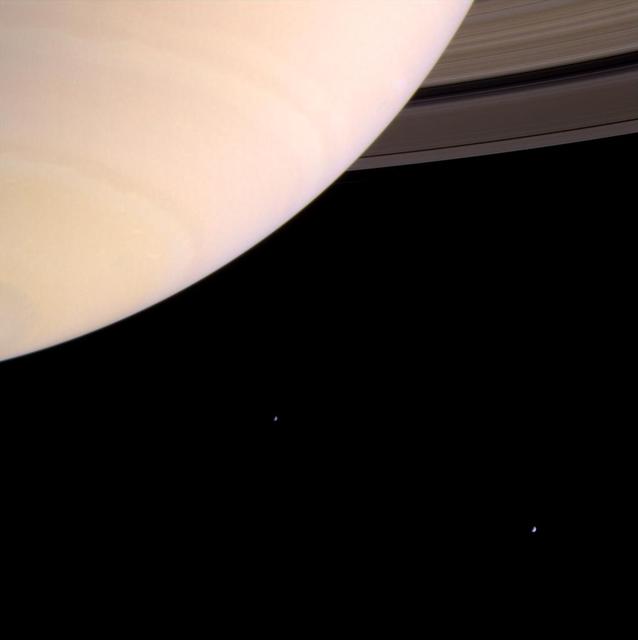
Ver en NASA ↗Looking up toward Saturn southern hemisphere, NASA Cassini spacecraft pictures a pair of the planet moons orbiting in the distance. Tethys and Rhea orbit in the plane of the planet rings, but appear to be below the planet in this view.
Ver en NASA ↗Contenido y metadatos proporcionados por la NASA Image and Video Library.