





/NASA’s%20Artemis%20III%20Announcement%20(Official%20NASA%20Trailer)~thumb.jpg)

This spectacular image of Saturn clouds looks obliquely across the high northern latitudes. The Sun is low on the horizon here, making the vertical extent of the clouds easier to see. Cloud bands surrounding the vortex
Ver en NASA ↗🚀 Biblioteca espacial oficial
Imágenes y vídeos de NASA
Explora el catálogo multimedia público de NASA sin salir de TuPortalNews.
Explora temas destacados
Selecciona un tema o realiza una búsqueda personalizada.
4.237 resultados en NASA
These images compare surface features observed by NASA Cassini spacecraft at the Xanadu region on Saturn moon Titan left, and features observed by NASA Galileo spacecraft on Jupiter cratered moon Callisto right.
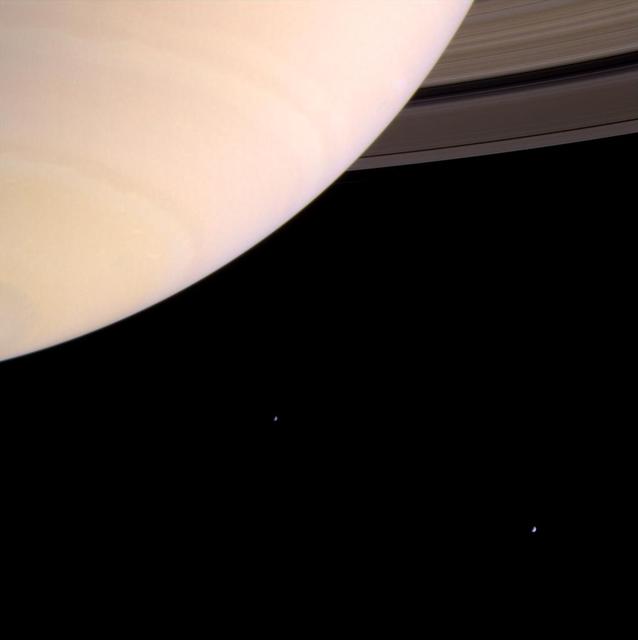
Ver en NASA ↗The shadow of the moon Mimas creates a smudge on the southern hemisphere of Saturn in this view from NASA Cassini spacecraft. Mimas does not appear here, but it does cast its shadow on the planet in the lower left of the image.
Ver en NASA ↗These two natural color views taken 11 hours -- one Saturn day -- apart by NASA Cassini spacecraft help scientists measure wind speeds in the huge storm seen here in the planet northern hemisphere.
Ver en NASA ↗This image from NASA Cassini spacecraft reveals the wind patterns within a large vortex that was spawned by a giant northern storm on Saturn. The arrows indicate the local direction of the winds.
Ver en NASA ↗This image obtained by NASA Cassini spacecraft shows some of the more bizarre trails that were dragged out from Saturn F ring by objects about a half mile 1 kilometer in diameter.
Ver en NASA ↗An enhanced close-up view shows at least two distinct jets spraying a mist of fine particles from the south polar region of Enceladus. This image shows the night side of Saturn and the active moon against dark sky
Ver en NASA ↗This image depicts the test firing of a J-2 engine in the S-IVB Test Stand at the Marshall Space Flight Center (MSFC). The J-2, developed by Rocketdyne under the direction of MSFC, was propelled by liquid hydrogen and liquid oxygen. A single J-2 was utilize…
Ver en NASA ↗Pictured is a J-2 engine being processed at Marshall Space Flight Center (MSFC). A single J-2 engine was utilized on the S-IVB stage, the second stage of the Saturn IB and the third stage of the Saturn V vehicles, while a cluster of five J-2 engines powered t…
Ver en NASA ↗Pictured is a J-2 engine being processed at Marshall Space Flight Center (MSFC). A single J-2 engine was utilized on the S-IVB stage, the second stage of the Saturn IB and the third stage of the Saturn V vehicles, while a cluster of five J-2 engines powered t…
Ver en NASA ↗A J-2 engine undergoes static firing. The J-2, developed under the direction of the Marshall Space Flight Center, was propelled by liquid hydrogen and liquid oxygen. A single J-2 was utilized in the S-IVB stage (the second stage for the Saturn IB and third st…
Ver en NASA ↗This beautiful look at Saturn south polar atmosphere, captured by NASA's Cassini spacecraft, shows the hurricane-like polar storm swirling there. Sunlight highlights its high cloud walls, especially around the 10 o'clock position.
Ver en NASA ↗The night sides of Saturn and Tethys are dark places indeed. This image from NASA Cassini spacecraft shows shadows are darker areas than sunlit areas, and in space, with no air to scatter the light, shadows can appear almost totally black.
Ver en NASA ↗This view of Saturn's A ring features a lone 'propeller,' one of many such features created by small moonlets embedded in the rings as they attempt, unsuccessfully, to open gaps in the ring material, taken by NASA's Cassini spacecraft on Sept. 13, 2017.
Ver en NASA ↗CLOSE-UP OF H-1 ENGINE INSTALLED ON SATURN S-1B STAGE (SA-T) NEAR PROPULSION AND STRUCTURAL TEST FACILITY (BUILDING 4572) AT THE GEORGE C. MARSHALL SPACE FLIGHT CENTER.
Ver en NASA ↗Saturn - Tethys from 594,000 kilometers 368,000 miles Away
Ver en NASA ↗Saturn - Enceladus from a Distance of 119,000 kilometers 74,000 miles
Ver en NASA ↗Although it appears empty from a distance, the Encke gap in Saturn A ring has three ringlets threaded through it, two of which are visible here from NASA Cassini spacecraft.
Ver en NASA ↗NASA Cassini orbiter shows Saturn main rings, seen here on their lit face, appear much darker than normal. That because they tend to scatter light back toward its source -- in this case, the Sun.
Ver en NASA ↗From afar, Saturn rings look like a solid, homogenous disk of material. But upon closer examination from NASA Cassini spacecraft, we see that there are varied structures in the rings at almost every scale imaginable.
Ver en NASA ↗Why does Saturn look like it been painted with a dark brush in this infrared image, but Dione looks untouched? NASA Cassini spacecraft took this image in a wavelength that is absorbed by -- methane.
Ver en NASA ↗Although solid-looking in many images, NASA Cassini orbiter shows that Saturn rings are actually translucent. In this picture, we can glimpse the shadow of the rings on the planet through the A and C rings themselves, towards the lower right corner.
Ver en NASA ↗Not all of Saturn rings are created equal: here the C and D rings appear side-by-side, but the C ring, which occupies the bottom half of this image, clearly outshines its neighbor. This image is from NASA Cassini spacecraft.
Ver en NASA ↗Andy Aldrin, son of Apollo 11 astronaut Buzz Aldrin, introduces Apollo 11 astronaut Michael Collins, during the Apollo 50th Gala, presented by Northrop Grumman. The event was held inside the Apollo/Saturn V Center at the Kennedy Space Center Visitor Complex i…
Ver en NASA ↗Contenido y metadatos proporcionados por la NASA Image and Video Library.