





/NASA’s%20Artemis%20III%20Announcement%20(Official%20NASA%20Trailer)~thumb.jpg)
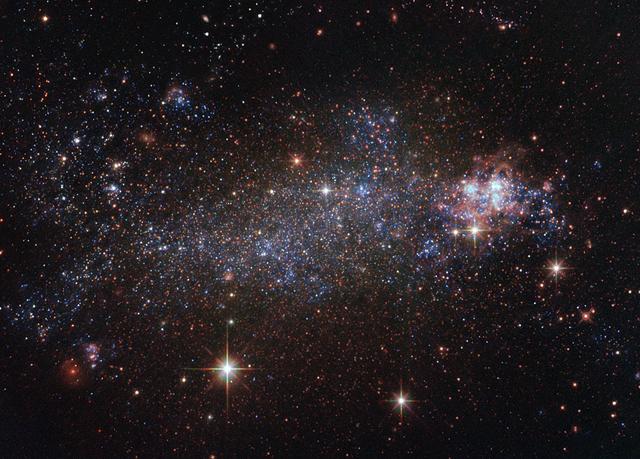

This image shows the nuclei of comets Tempel 1 and Hartley 2, as imaged by NASA Deep Impact spacecraft, which continued as an extended mission known as EPOXI.
Ver en NASA ↗🚀 Biblioteca espacial oficial
Imágenes y vídeos de NASA
Explora el catálogo multimedia público de NASA sin salir de TuPortalNews.
Explora temas destacados
Selecciona un tema o realiza una búsqueda personalizada.
1.049 resultados en NASA
This image shows comet Tempel 1 as seen through the clear filter of the medium resolution imager camera on NASA Deep Impact. It was taken on June 30, 2005.
Ver en NASA ↗This image shows comet Tempel 1 as seen through the clear filter of the medium resolution imager camera on NASA Deep Impact. It was taken on July 1, 2005.
Ver en NASA ↗This pair of images shows the before-and-after comparison of the part of comet Tempel 1 that was hit by the impactor from NASA Deep Impact spacecraft.
Ver en NASA ↗Is it a bird, or a plane? No, it comet Siding Spring streaking across the sky, as seen by NASA Wide-field Infrared Survey Explorer, or WISE. An animation is available at the Photojournal.
Ver en NASA ↗These two images show the different views of comet Tempel 1 seen by NASA Deep Impact spacecraft left and NASA Stardust spacecraft right.
Ver en NASA ↗This zoomed-in image from the High-Resolution Instrument on NASA EPOXI mission spacecraft shows the particles swirling in a now storm around the nucleus of comet Hartley 2.
Ver en NASA ↗This annotated image depicts the backup landing site Site C chosen for ESA Rosetta spacecraft Philae lander.
Ver en NASA ↗Three of NASA contributions to the ESA Rosetta mission are pictured here: an ultraviolet spectrometer called Alice top, the Ion and Electron Sensor IES bottom left, and the Microwave Instrument for Rosetta Orbiter MIRO bottom right.
Ver en NASA ↗This annotated image depicts two of the five potential landing sites for ESA Rosetta mission Philae lander.
Ver en NASA ↗The Onboard Scientific Imaging System OSIRIS on the European Space Agency Rosetta spacecraft captured this parting shot of the mission Philae lander after its separation from the mother ship on Nov. 12, 2014.
Ver en NASA ↗This annotated image depicts four of the five potential landing sites for ESA Rosetta mission Philae lander.
Ver en NASA ↗The Philae lander of the European Space Agency Rosetta mission took this parting shot of its mother ship, Rosetta, shortly after separation on Nov. 12, 2014. The image was taken with the lander CIVA-P imaging system.
Ver en NASA ↗694B8186.NEF
Ver en NASA ↗008K0235.NEF
Ver en NASA ↗744R2278.NEF
Ver en NASA ↗NASA New Millennium Deep Space 1 spacecraft approaching the comet 19P/Borrelly.
Ver en NASA ↗Comet Hale-Bopp is seen in the constellation Lacerta at 5:18 a.m. on March 9, 1997. North is to the left of the comet in this photograph, which was taken on Merritt Island, Florida, near Kennedy Space Center
Ver en NASA ↗This image shows the initial ejecta that resulted when NASA Deep Impact probe collided with comet Tempel 1 on July 3, 2005. It was taken by the spacecraft high-resolution camera 13 seconds after impact.
Ver en NASA ↗This image shows comet Tempel 1 approximately 5 minutes before NASA Deep Impact probe smashed into its surface. It was taken by the probe impactor targeting sensor.
Ver en NASA ↗This image layout depicts changes in the surface of comet Tempel 1, observed first by NASA Deep Impact Mission in 2005 top right and again by NASA Stardust-NExT mission on Feb. 14, 2011 bottom right.
Ver en NASA ↗This composite image shows the three small worlds NASA Stardust spacecraft encountered during its 12 year mission. Stardust performed a flyby of asteroid Annefrank in 2002, Comet Wild in 2004, and Tempel 1 in 2011.
Ver en NASA ↗This image from the High-Resolution Instrument on NASA EPOXI mission spacecraft shows part of the nucleus of comet Hartley 2. The sun is illuminating the nucleus from the right. A distinct cloud of individual particles is visible.
Ver en NASA ↗When NASA Deep Impact probe collided with Tempel 1, a bright, small flash was created, which rapidly expanded above the surface of the comet. This flash lasted for more than a second.
Ver en NASA ↗Contenido y metadatos proporcionados por la NASA Image and Video Library.